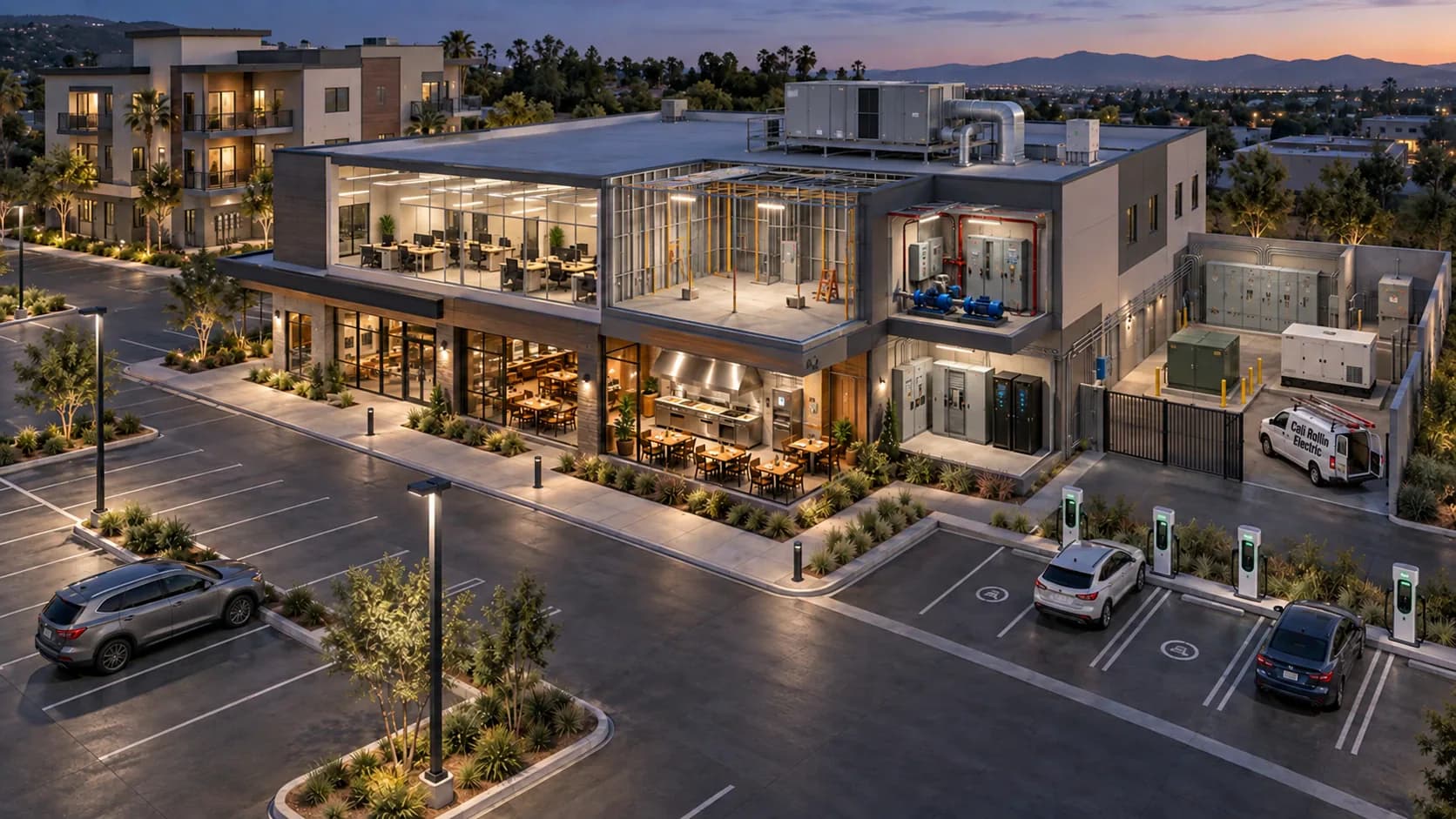
Infrastructure · Parking Lot & Site Lighting · Santa Clara County
Parking Lot & Site Lighting Installation & Repair in Santa Clara County
Dark lot tonight or an aging HID retrofit on the capital plan — same licensed contractor, one accountable contact.
Commercial parking lot, pole, and site lighting across Santa Clara County — pole and fixture replacement, knockdown and storm-damage emergency repair, HID-to-LED retrofit, underground circuit-fault repair, and Title 24 controls. We bid to the 2025 code, file the correct PG&E, SVP, or CPAU rebate, and install under NFPA 70E energized-work discipline.
- C-10 #1144031Licensed
- Bonded& Insured
- 15+ YearsExperience
- Santa Clara CountyService Area
Recent Work
From a Dark Lot to Full Brightness
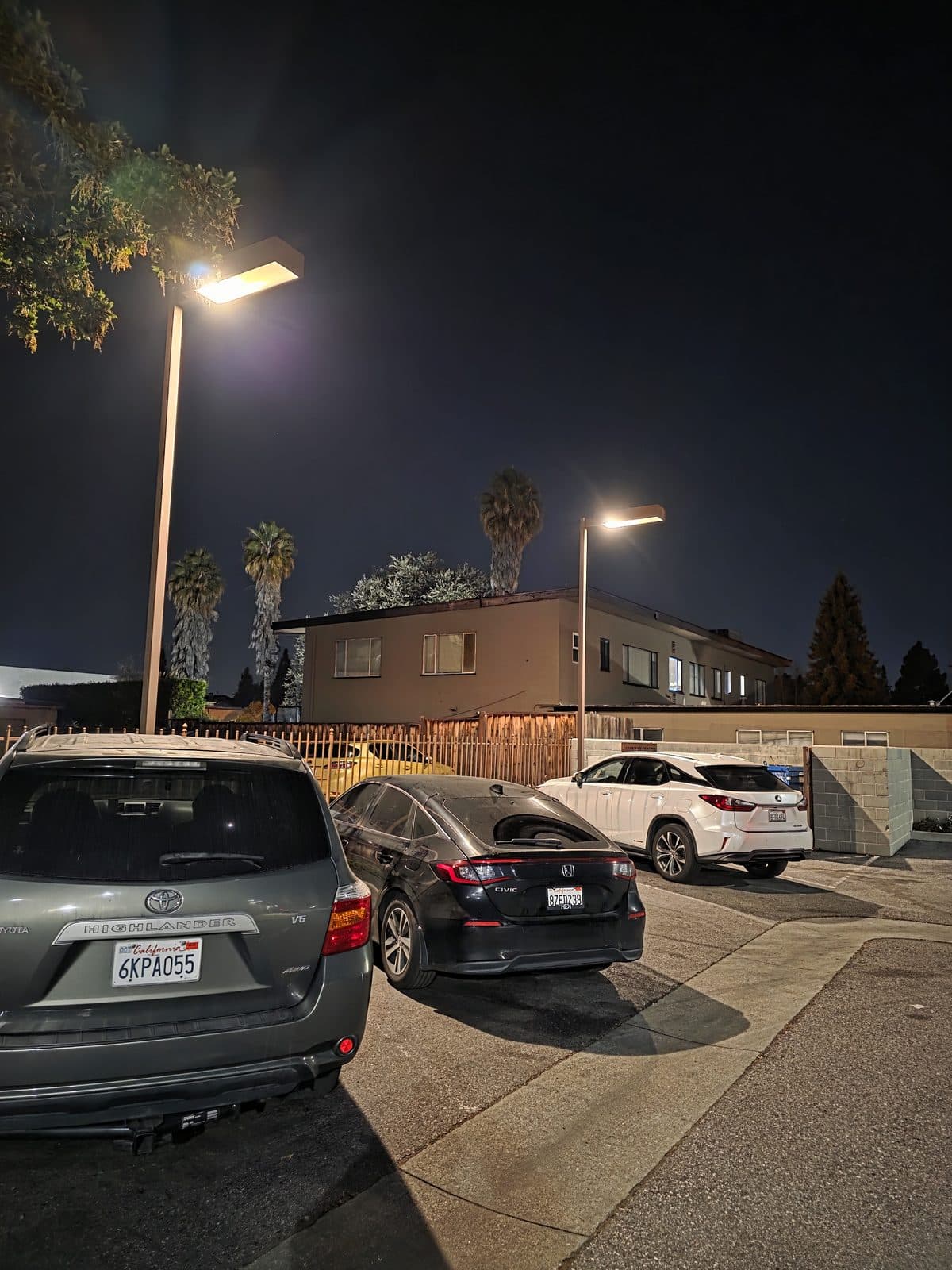
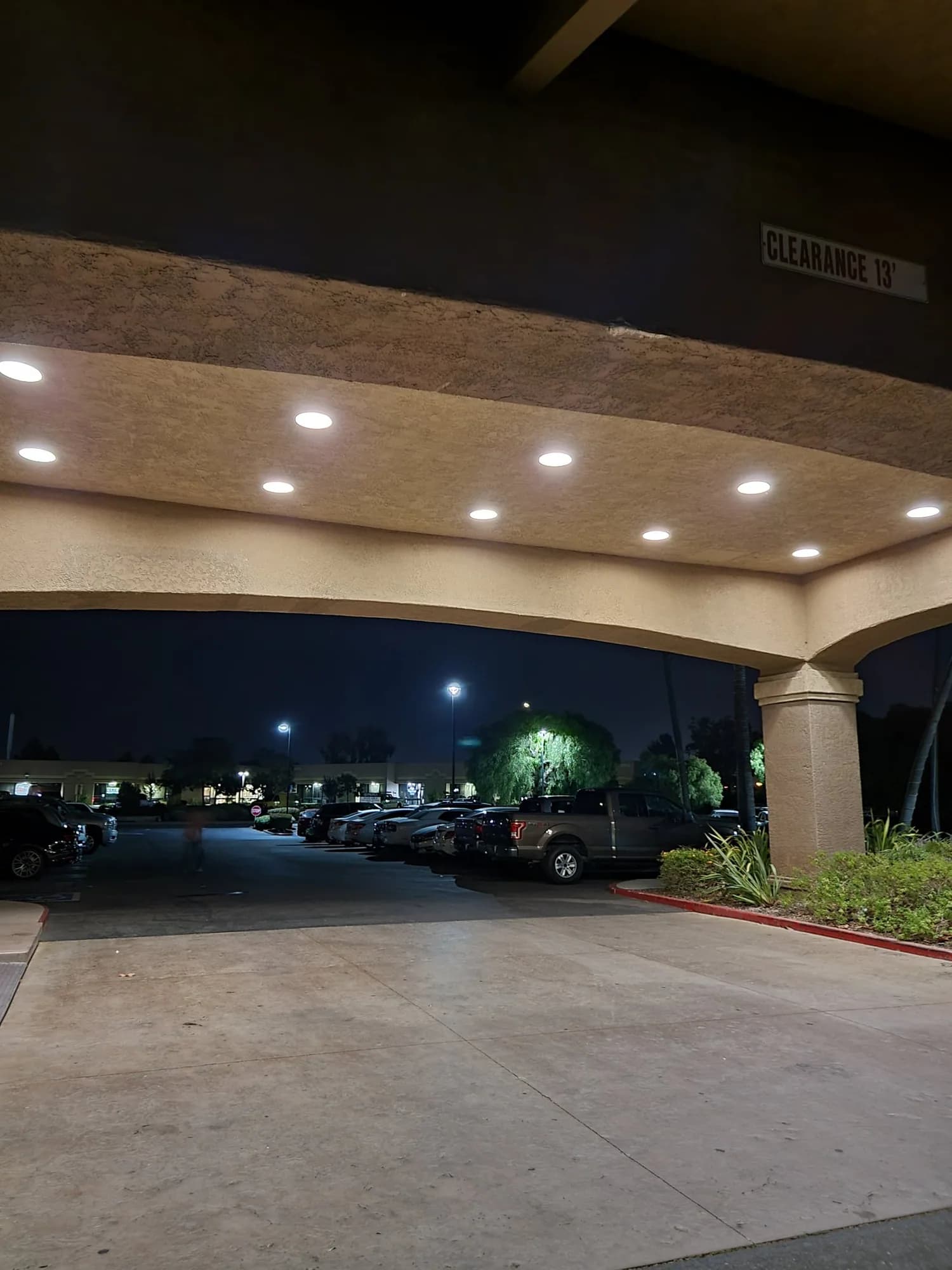
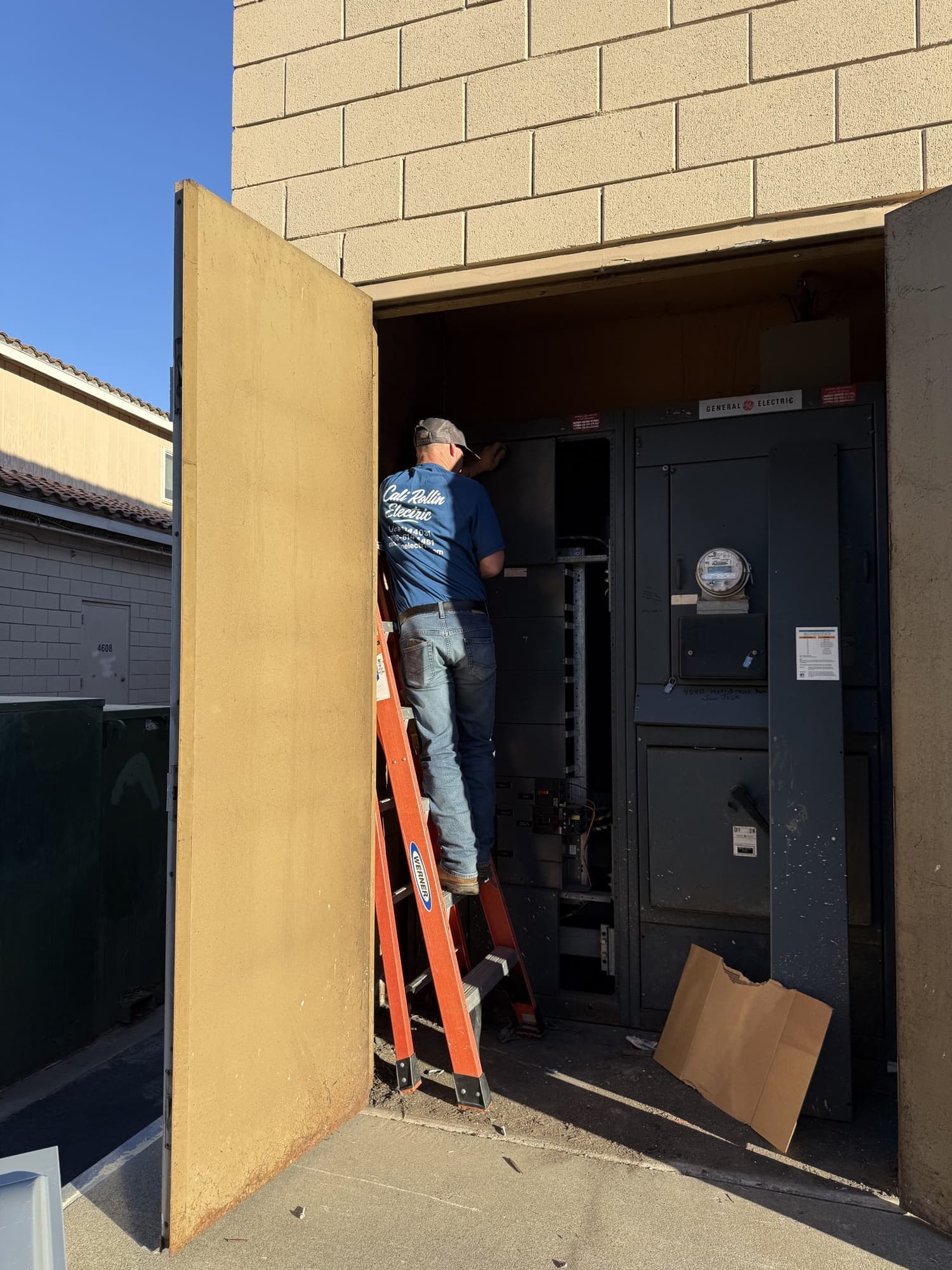
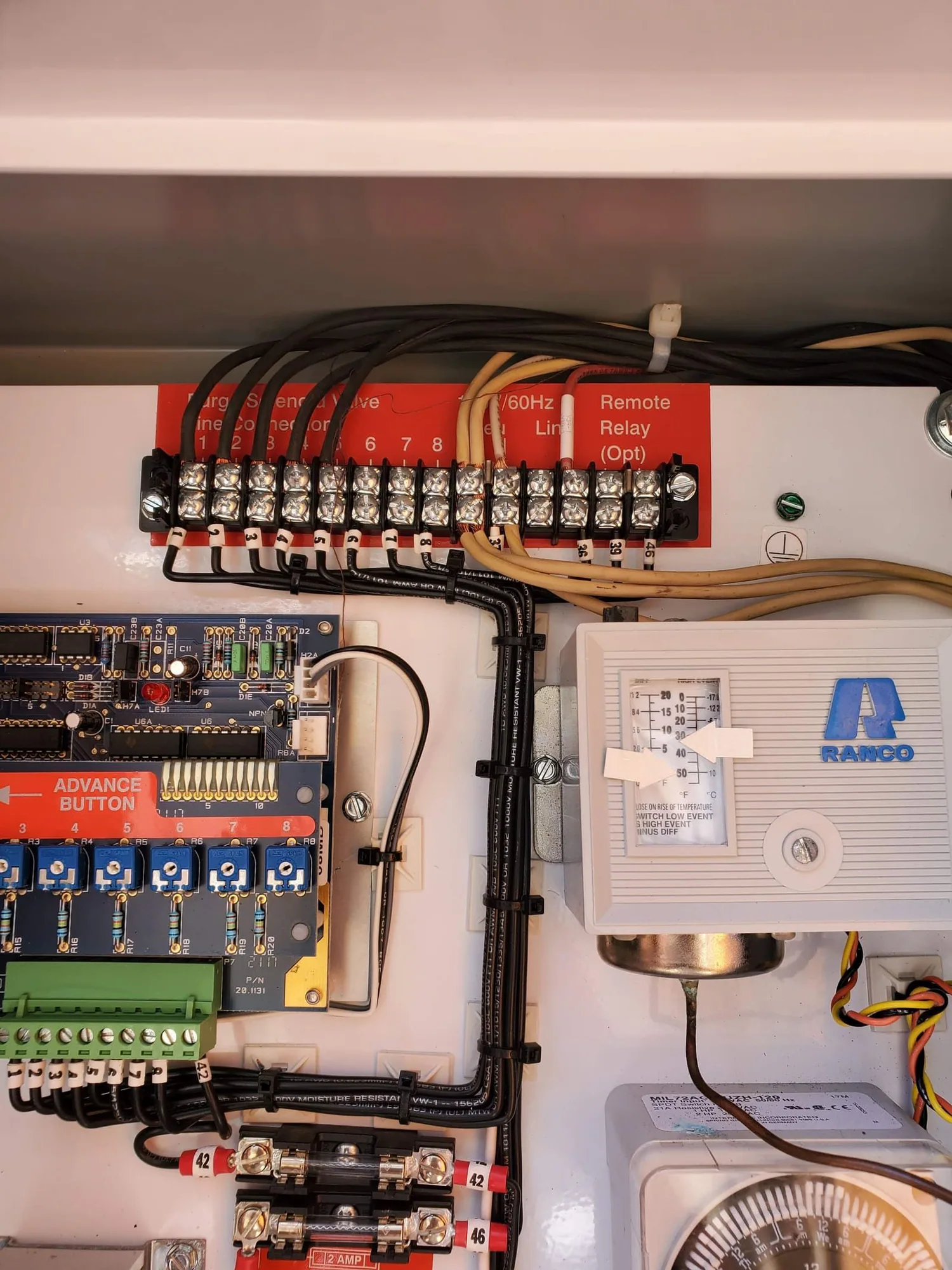
A failing pole light on a Santa Clara County property — caught on a site walk, diagnosed, and brought back to full, even output. It is the same sequence we run on outage, dim-lamp, and knockdown calls across the county.

Light out — a dead pole fixture flagged on a site walk.

Bad light — an HID lamp cycling red at end of life, a classic pre-failure symptom.

Back on — full, even brightness across the lot after the repair.
End-to-End Site-Lighting Scope
Two Jobs — The Dark Lot Tonight and the Planned Retrofit
Site lighting splits into two very different calls: the urgent break-fix — an outage, a knocked-down pole, a half-dark lot drawing tenant and security complaints — and the planned capital retrofit of aging HID to LED for lower energy cost, utility rebates, and Title 24 compliance. We handle both as one licensed scope, from the concrete base to the control wiring.
Full pole and luminaire replacement, including the concrete base, anchor-bolt template, and conduit stub-ups. The metal pole that carries the circuit gets a code-correct handhole and an equipment-grounding terminal — not just a fixture bolted to the top.
A vehicle-struck or storm-sheared pole is its own emergency. We make the circuit electrically safe first, then saw-cut and rebuild the base — conduit, conductors, anchor bolts, grounding — to NEC. This is licensed electrical work, not a maintenance lamp-swap.
Conversion of aging metal-halide and high-pressure-sodium fixtures to LED — typically 15,000 to 50,000 hours of rated life, lower energy cost, and far fewer maintenance trips. Specified by photometric layout for foot-candle uniformity, not a one-for-one wattage swap.
Automatic daylight shutoff, scheduling, and motion-sensing controls are required by California Title 24 Part 6 §130.2, not a nice-to-have. We design the controls into the retrofit so the lot passes inspection and qualifies for the controls portion of the rebate.
Site-lighting circuits fail underground from water intrusion, rodent damage, and bad in-grade splices. We locate the fault, repair or re-run the conductor at proper cover per NEC 300.5, and protect the run — PVC Sch 40 versus Sch 80 where the run is subject to physical damage.
Building-perimeter wall packs, in-grade and surface bollards, and pathway fixtures — specified with BUG-rated full-cutoff optics and the right color temperature so light lands on the walking surface, not in a neighbor's window.
What Goes Wrong on a Lot
The Failures We See in the Field
Most site-lighting problems aren't a burned-out lamp. They're a pole sheared at the base, a control that failed silently, a buried conductor faulted by water or rodents, or a retrofit done by wattage instead of by photometrics. Here's what we actually find — and fix.
A vehicle strike or storm shears the pole at the base, leaving live conductors in an open base. This is the emergency that needs an electrician, not a maintenance crew — make-safe first, then rebuild to code.
When the control fails one way, the lot burns 24/7 — wasted energy and a Title 24 noncompliance. Fail the other way and the lot goes dark, which is the liability exposure you most want to avoid.
Water intrusion, rodent damage, and bad in-grade splices fault the buried circuit. The lot half-lights or nuisance-trips, and the fault is invisible from the surface until it's located and dug.
Corroded HID circuits nuisance-trip under LED inrush, and a careless driver or ballast-bypass mismatch shortens fixture life. Missing surge protection on the drivers turns a routine outage into a fleet of dead fixtures.
Inadequate shielding throws light trespass onto neighbors; the wrong color temperature violates a dark-sky cap like Palo Alto's 2700K limit. Fixing it after install means buying the optic twice.
Pole lighting and new circuits typically need plan review, and trenching that reaches public right-of-way in unincorporated county needs a Roads & Airports encroachment permit before the building permit issues.
Why a Dark Lot Matters
A poorly lit lot is a documented driver of injury claims, and an owner can be liable when they knew about the outage and didn't act. Managers often don't notice an outage themselves — it comes in as a tenant or security complaint. Getting the lot back to full output quickly is both a safety and a liability question.
Report an OutageTitle 24 Outdoor Controls
The Controls a Lamp-Only Retrofit Quietly Skips
California Title 24 Part 6 §130.2 makes outdoor lighting controls mandatory — they are not an upsell. A retrofit that swaps fixtures but ignores these requirements does not pass inspection and forfeits the controls portion of the rebate. The 2025 cycle, effective January 1, 2026, tightens them further for parking areas and garages.
| Automatic daylight shutoff | A photocontrol or astronomical time-switch turns outdoor lighting off when daylight is available — mandatory under Title 24 §130.2 for outdoor lighting. |
| Three-state auto-scheduling | The 2025 cycle requires scheduling that steps lighting between full, a reduced level, and full-OFF — not just on or off. |
| Motion / occupant sensing | Outdoor fixtures must reduce output on a no-occupancy timeout, and parking areas, garages, and loading require occupant-sensing with at least one reduced step of design power. |
| Zone wattage limits | Outdoor controls are zoned by wattage; parking garages and loading carry a tighter single-zone limit than general outdoor zones. We design the zoning so each control covers a compliant load. |
| BUG / shielding | Luminaires of 6,200 lumens and up must meet BUG/shielding limits per CALGreen §5.106.8 and IES TM-15 — the spec that controls glare and light trespass. |
Code, Grounding & Permits
Pole Grounding, Underground Cover, and the Right Permit
A site-lighting circuit is a buried, outdoor, often metal-pole system — which means the code that governs it is real and specific. We bid the grounding, the cover, and the permit, not just the fixture.
| Pole as raceway (NEC 410.30) | A metal pole carrying the circuit needs an accessible handhole with a wet-location-rated cover and an equipment-grounding terminal accessible from it; the pole bonds to an equipment-grounding conductor recognized in 250.118. Short poles have a narrow exception when the conductors are reachable by removing the luminaire. |
| Outside circuits (NEC Article 225) | Conductors feeding poles follow Article 225 — overhead span conductor minimums and vertical clearances scale with span length, voltage, and whether the area is pedestrian or open to vehicle traffic. We size and route to those minimums, not to whatever the old run happened to be. |
| Underground cover (NEC 300.5) | Buried circuits get minimum cover by wiring method per Table 300.5, with a warning ribbon over the run. We carry the right cover depth, conduit detail, and PVC Sch 40 vs Sch 80 where the run is subject to physical damage as good practice. |
| Permit & plan review | Pole lighting and new circuits typically need an electrical permit and plan review. Each incorporated city runs its own AHJ; in unincorporated county a Roads & Airports encroachment permit is required before the building permit when trenching reaches public right-of-way. Permit fees are valuation-based and confirmed at submittal. |
| NFPA 70B maintenance (industry standard) | NFPA 70B (2023) recommends inspecting electrical equipment at least every 12 months, with condition-based intervals. It is an industry maintenance standard — not a California permit requirement — and it shapes our optional exterior-lighting maintenance program. |
Permit-Office Familiarity
Each Santa Clara County city runs its own permitting authority on its own timeline, and pole lighting plus new circuits typically need plan review. Unincorporated county work routes through County Planning & Development, and trenching into public right-of-way needs a Roads & Airports encroachment permit before the building permit issues.
Permit fees are valuation-based and confirmed at submittal — we don't quote a flat fee. We roll the actual fee into the project after the AHJ determination.
Discuss Your ProjectRebates & the Three-Utility Split
The Correct Rebate Depends on Which Utility Serves You
Santa Clara County is split across three utilities, and the rebate program follows your address — not a blanket “PG&E everywhere” assumption that mis-routes Santa Clara and Palo Alto. We confirm the utility, spec DLC-listed fixtures so the rebate qualifies, and sequence pre-approval before install so the incentive isn't forfeited. Amounts follow each program's qualifying-products catalog and your project's kWh savings, verified at application.
PG&E covers most of the county — San Jose, Cupertino, Sunnyvale, Mountain View, Gilroy, Morgan Hill, and more. Pole and wall-mounted directional LED for parking areas and walkways qualifies; parking-garage and lot LED runs roughly 50% more efficient than traditional HID lighting. DLC qualification is the standard for PG&E lighting rebates, and amounts follow the qualifying-products catalog and your project's kWh savings, verified at application. A 0% energy-efficiency financing option is also available.
PG&E Energy-Efficient Exterior Lighting ↗Silicon Valley Power serves the City of Santa Clara as a municipal utility, so Santa Clara properties route to SVP, not PG&E. Pre-approval before purchase and install is mandatory — installing first forfeits the rebate. The program rebates per-kWh saved with an outdoor-lighting bonus on parts and labor; networked controls must be DLC-qualified and carry a measurement-and-verification step after install. SVP currently offers a bonus on exterior LED plus networked-controls upgrades — deadlines apply, so confirm current terms with SVP. Program contact: savemoney@siliconvalleypower.com / 408-615-6650.
SVP Commercial Lighting Rebate ↗Palo Alto is served by its own municipal utility, City of Palo Alto Utilities, which runs its own commercial efficiency programs. Palo Alto site-lighting projects route to CPAU rather than PG&E, and we coordinate the application to the current CPAU program terms.
City of Palo Alto Utilities ↗If your lot job pairs with EV charging, two narrow programs may apply: the multifamily-only Communities in Charge program and the federal 30C charging credit — the latter requires the site to sit in a qualifying census tract, which much of urban Santa Clara County does not. We verify both against your specific address before promising anything. See our EV charger installation page for that scope.
Who We Serve
Property Managers, Boards, Owners & Builders
Most of our site-lighting calls come from the people responsible for a property's safety and budget — facilities managers, HOA boards, owners, and the GCs building the site in the first place. Each carries its own urgency and its own paperwork.
Office parks, retail centers, and industrial/flex sites. You often don't see the outage yourself — you hear it from a tenant or security. We give you one accountable contact for the outage call and the planned retrofit alike.
Shared parking, garages, and pathway lighting where a dark area is both a safety complaint and a board-meeting agenda item. Phased, predictable scope without a multi-year lock-in.
A poorly lit lot is a documented driver of injury claims — owners can be liable when they knew and didn't act. We keep the lot lit and the documentation clean, without the fear-sell.
Tenant-improvement and site work where the site-lighting scope has to land on code the first time — pole bases, conduit, controls, and the right utility rebate sequenced before install.
Parking, garages, and exterior pathways. When a lot job pairs with EV charging, the multifamily-only Communities in Charge program and the federal 30C credit may apply — both verified against the specific site before anything is promised.
Milpitas, North San Jose, Santa Clara, Sunnyvale, Gilroy, Morgan Hill. High-bay exterior and yard lighting where HID-to-LED plus occupant-sensing controls cut both energy and maintenance trips.
What Drives the Number
Why We Quote After the Site Walk, Not Before
Every lot is different, and an honest price comes from the assessment — not a web form. We won't print a per-fixture or per-foot number here, because the real cost turns on the conditions we find on the walk. The drivers below are what move it.
- →Pole count & condition— how many poles, whether bases and conduit are reusable, and whether any are knockdowns needing a rebuild.
- →Photometric target— the foot-candle uniformity the lot needs drives fixture count and optic, not a one-for-one swap.
- →Controls scope— the mandatory Title 24 §130.2 photocell, scheduling, and occupant-sensing controls and their zoning.
- →Underground condition— buried conductor faults, trench length, and whether the run needs re-pulling at proper cover.
- →Permit & encroachment— plan review at the city AHJ and any Roads & Airports encroachment permit for ROW trenching.
- →Rebate offset— the qualifying PG&E / SVP / CPAU rebate that comes back against the equipment, verified at application.
Transparent on Rate
Labor is billed at a transparent $150/hr rate. We're honest that permit fees are valuation-based and confirmed at submittal, and that the rebate amount follows the program catalog and your kWh savings — not a number we can pretend to know before the assessment.
Schedule the AssessmentHow a CRE Site-Lighting Project Runs
Eight Steps — Assess, Make-Safe, Design, Pre-Approve, Permit, Install, Close, Maintain
A site-lighting job looks simple from the parking lot and has a stack of moving parts underneath — utility pre-approval, AHJ plan review, pole grounding, underground cover, and controls commissioning. We front-load the documentation so the install runs clean and your closeout package is ready when the lights come on.
Why Cali Rollin Electric
A Licensed Local Team, Bid to Code
Plenty of firms will swap a parking-lot fixture. Fewer carry the C-10 license that a knockdown rebuild and an energized make-safe actually require, file the correct utility rebate for your address, and bid the pole grounding, trench detail, and mandatory controls instead of dropping them to win on price. That gap is where we work.
C-10 #1144031. 15+ years on the trade. Morgan Hill-based, serving all of Santa Clara County. 408-614-4451.
What Customers Say
Reviewed by Real Santa Clara County Customers
Our commercial work is verified by Google reviews from property owners and facilities managers across the county. Read the live, unfiltered feedback on the Google Business Profile — and verify our C-10 license standing directly with the California State License Board.
Credentials
- →C-10 #1144031— California State License Board
- →DBE Certified— Disadvantaged Business Enterprise
- →Google Guaranteed— Local Services Ads verified
- →Fully insured + bonded
- →15+ years— trade experience
Frequently Asked Questions
Parking Lot & Site Lighting — FAQ
My parking lot pole got hit or knocked down — what's the emergency process?+
A knocked-down or storm-sheared pole is a distinct emergency, not a routine repair, because it usually leaves live conductors in an open base. The first step is always to make the circuit electrically safe — de-energizing and isolating the run before anyone works near it. Once it's safe, we rebuild: saw-cut and re-pour or repair the concrete base, set the anchor-bolt template, run new conduit and conductors, re-establish grounding, and set the new pole and fixture to NEC. This is licensed electrical work under NEC Articles 410 and 225, which is why an electrician — not a general maintenance crew — should handle it. We promise only the response time we can actually hold, and we make-safe first, every time.
Do I have to upgrade controls when I retrofit to LED, or can I just swap fixtures?+
You generally cannot just swap lamps. California Title 24 Part 6 §130.2 makes outdoor lighting controls mandatory: automatic daylight shutoff (a photocontrol or astronomical time-switch), automatic scheduling that steps lighting between full, a reduced level, and full-OFF, and motion or occupant sensing that reduces output on a no-occupancy timeout. The 2025 cycle, effective January 1, 2026, further requires parking areas, garages, and loading to have occupant-sensing with at least one reduced step of design power. A lamp-only retrofit that ignores these controls does not comply with current code — and it also leaves the controls portion of the utility rebate on the table. We design the controls into the retrofit from the start.
How do parking-lot lighting rebates work, and who handles them?+
Rebates depend on which utility serves your property, and Santa Clara County is split three ways: PG&E covers most of the county, Silicon Valley Power serves the City of Santa Clara, and City of Palo Alto Utilities serves Palo Alto. The fixtures generally have to be DLC-listed to qualify, and the rebate amount follows the qualifying-products catalog and your project's kWh savings, verified at application — we don't quote a per-fixture dollar figure up front because the catalog and program terms change. The most important rule is timing: SVP requires pre-approval before purchase and install, and installing first forfeits the rebate. We run the full sequence — eligibility check, pre-approval, install, and closeout — so the incentive is captured, not lost.
Which utility serves my property — PG&E or Silicon Valley Power?+
It depends on the city. If your property is in the City of Santa Clara, you're served by Silicon Valley Power, a municipal utility, and your lighting rebate routes through SVP. If you're in Palo Alto, you're served by City of Palo Alto Utilities, also municipal, and your program routes through CPAU. Most other cities in the county — San Jose, Cupertino, Sunnyvale, Mountain View, Gilroy, Morgan Hill, and others — are PG&E territory. Assuming PG&E everywhere is a common mistake that mis-routes Santa Clara and Palo Alto rebates and service coordination, so we confirm the correct utility for your specific address before filing anything.
What does Title 24 require for outdoor and parking-lot lighting in 2026?+
California is on the 2025 Title 24 Part 6, effective January 1, 2026. For outdoor and parking-lot lighting, the mandatory controls under §130.2 include automatic daylight shutoff, three-state automatic scheduling (full, a reduced level, and full-OFF), and motion or occupant sensing that reduces output on a no-occupancy timeout. Parking areas, garages, and loading specifically require occupant-sensing with at least one reduced step of design power. Power for the lot is also budgeted by lighting zone — most commercial Santa Clara County sites fall in the moderate zones — and luminaires of 6,200 lumens and up must meet BUG/shielding limits per CALGreen §5.106.8 to control glare and light trespass. We bid to these requirements rather than to the superseded 2022 cycle.
Do I need a permit for parking-lot or pole lighting?+
In most cases, yes. Pole lighting and new circuits typically require an electrical permit and plan review, and each incorporated city runs its own permitting authority — San Jose adopts the California Electrical Code through its municipal code, with the 2025 code applying to applications on or after January 1, 2026. In unincorporated Santa Clara County, building and trade permits go through County Planning & Development, and any trenching, utility connections, or pole work in or adjacent to county right-of-way also needs a Roads & Airports encroachment permit, which must be obtained before the building permit issues. Permit fees are valuation-based and confirmed at submittal, so we don't quote a flat permit fee — we roll the actual fee into the project after the AHJ determination.
How long does a typical LED parking-lot retrofit take?+
It's genuinely scope-dependent — a single failed pole reads very differently from a full-lot HID-to-LED conversion with new controls and a rebate filing. Rather than promise a fixed timeline we can't hold for your specific site, we start with an assessment: a site walk to inventory poles, fixtures, and controls, locate any faults, and map the Title 24 controls and BUG requirements. From that, you get an honest schedule alongside the quote. The recurring long-pole items are utility pre-approval (which must come before install for SVP), AHJ plan review, and any required networked-controls measurement-and-verification step after the fixtures go in.
What's the difference between a thorough bid and a cheap one?+
The cheap bid usually quotes fixtures by wattage, skips the photometric layout, leaves out the Title 24 §130.2 controls, ignores pole grounding and the handhole, hand-waves the trench detail, and doesn't file the rebate. The thorough bid does the opposite: a photometric layout for foot-candle uniformity, named DLC-listed fixtures, NEC 410.30 pole grounding and handhole, NEC 300.5 underground cover and conduit detail, the mandatory controls, BUG-rated optics for your jurisdiction's dark-sky rules, and the correct utility rebate sequenced before install. The lowball looks cheaper on paper and costs more once the inspection fails or the rebate is forfeited. We bid to code minimum and note any bring-up the plans missed, so the price is defensible.
Start With the Site Walk
The fastest first step is a site assessment. If you have it, bring your most recent electricity bill — the rate schedule and kWh history are the input to the rebate calculation.
Schedule a Site AssessmentGet In Touch
Parking Lot & Site Lighting Consultation
Include your property address, the number of poles or fixtures, and what's happening — an outage, a downed pole, or a planned retrofit. We'll follow up to schedule the site assessment and identify your utility and rebate path.
- →Knockdown & emergency— make-safe first, then rebuild to NEC
- →Correct utility rebate— PG&E, SVP, or CPAU by city
- →Title 24 controls— designed in, not skipped
- →C-10 #1144031— licensed CA contractor
Parking Lot & Site Lighting
A Dark Lot Is a Liability. Let's Get It Lit — to Code.
Parking Lot & Site Lighting Service Area — Santa Clara County (15 cities)