FPE Stab-Lok and Zinsco Replacement
FPE Stab-Lok and Zinsco Panels Are a Known Fire Hazard. Your Insurer May Already Know.
Federal Pacific Electric Stab-Lok breakers fail to trip under overload at documented rates, and Zinsco breakers can weld themselves to the bus so they cannot trip at all. Both sit in Santa Clara County homes built between 1950 and 1990, and carriers are dropping the homeowners who have them. Our team replaces them in full, permit and inspection included.
- Era these panels were installed
- 1950-1990Era these panels were installed
- Replacement starts at
- $5,500+Replacement starts at
- Typical replacement time
- 4-8 hrTypical replacement time
- Optional upgrade the same day
- 100A→200AOptional upgrade the same day
Quick answer
What the evidence shows
FPE Stab-Lok and Zinsco vs a modern panel
The failure modes are different between FPE and Zinsco, but the outcome is the same: breakers that do not open when they should. That is the entire purpose of a circuit breaker, so there is no version of this that gets repaired into safety.
| Factor | FPE / Zinsco Panel | Modern Replacement ★ |
|---|---|---|
| Breaker trip performance | FPE Stab-Lok: documented failure to trip under overload | Industry-standard trip performance |
| Zinsco failure mode | Breakers weld to the aluminum bus and cannot trip | Not a mechanism used in modern panels |
| Regulatory history | FPE investigated by the CPSC, no recall issued, failures documented | No outstanding safety issues |
| Replacement breakers | No UL-listed replacement breakers are made for Zinsco panels | Stocked by every supply house |
| Insurance impact | Carriers flagging, non-renewing, and declining new policies | No insurance concerns |
| Resale impact | Buyers' inspectors call it out, deals stall at closing | No issue |
| Code compliance | Installed to the code of its era, not the current California Electrical Code | Current code compliant |
| Recommended action | Replace, do not repair | No action needed |
The core problem
FPE Stab-Lok trip failure
25% to 60%
Independent testing, rising as the panel ages
Zinsco failure mode
Bus bar welding
Breakers that cannot trip, even on a dead short
Both panels look completely normal from the outside. Both fail internally. Neither can be safely refurbished, only replaced.
From the field
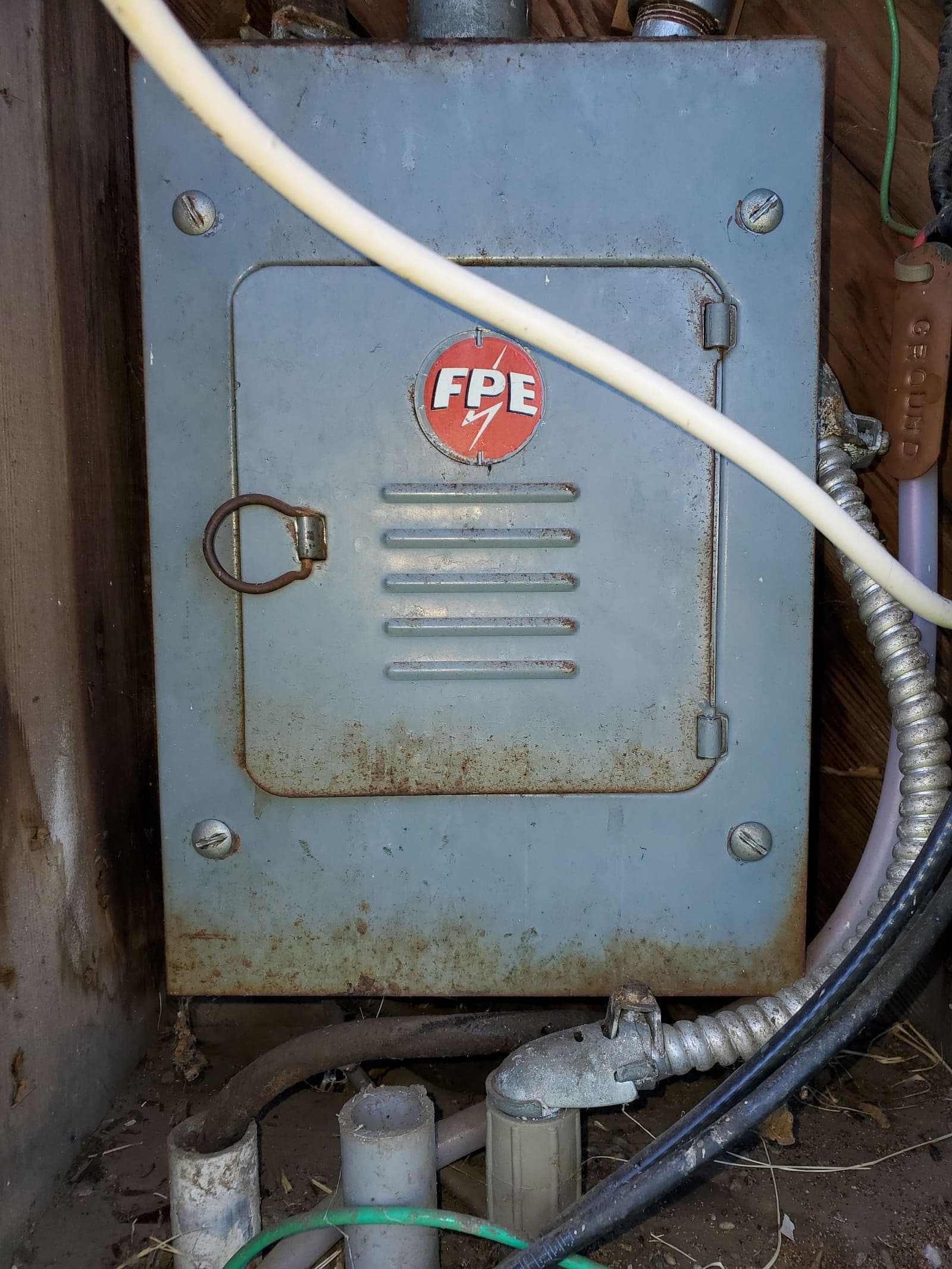
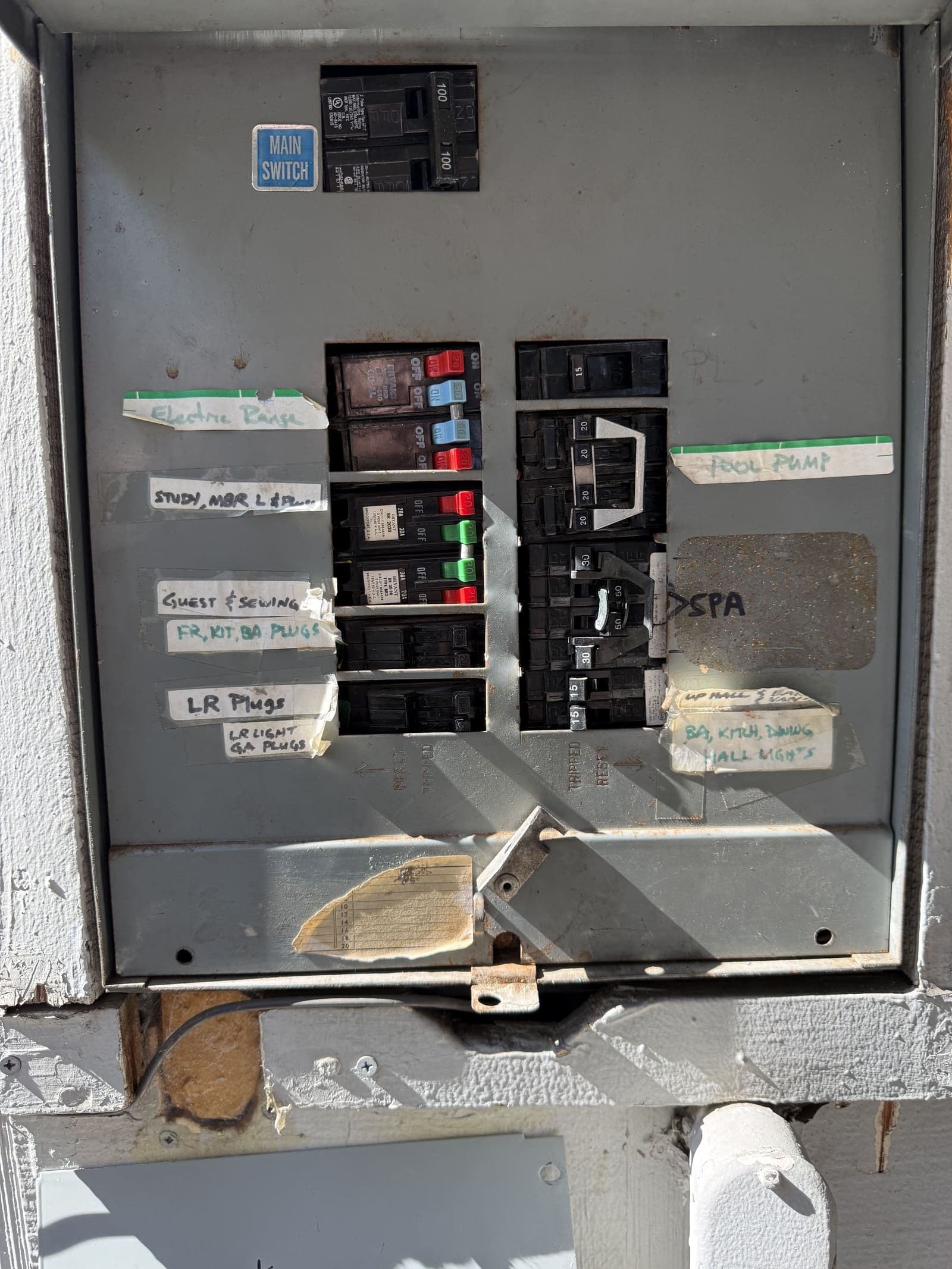
Hazardous panels we have taken out
.jpg&w=3840&q=75)
.jpg&w=3840&q=75)
Identify it yourself
How to tell what is on your wall
You do not need an electrician to work out which brand you have. Open the outer door of the panel (leave the inner cover alone, that is our job) and look for these tells.
If it is a Federal Pacific
- A label reading Federal Pacific Electric, FPE, or Stab-Lok, inside the door or on the panel face.
- Narrow breakers with a distinctive red stripe across the toggle.
- Breakers that push straight onto the bus instead of clipping over it. That stab-in connection is where the name comes from, and where the contact failures happen.
If it is a Zinsco
- A label reading Zinsco, GTE-Sylvania, Sylvania, or Challenger.
- Color-coded breaker toggles: blue for 15A, red for 20A, green for 30A. No other brand used that scheme, so it is the fastest visual confirmation there is.
- Breakers that clip over a horseshoe-shaped connection on an aluminum bus, which is the joint that oxidizes, heats, and eventually welds shut.
Where these panels turn up
Stab-Lok equipment went into new construction from the 1950s into the early 1980s, and Zinsco (later GTE-Sylvania) through roughly the same stretch. Santa Clara County filled in with tract housing through exactly that period, so the neighborhoods built during the post-war and semiconductor booms are the ones still carrying original service equipment. A panel from that era is now 45 to 70 years old, and it was never designed for a modern all-electric load in the first place.
Not sure what you are looking at? Text a photo of the open panel door to (408) 614-4451 and we will tell you what it is.
What the job actually involves
A full replacement, to the current code
Everything comes out: the enclosure, the bus assembly, and every breaker. On an FPE panel the contact problem is built into the chassis, so new breakers on the old bus change nothing. On a Zinsco panel there is no option at all, because no UL-listed replacement breakers are manufactured for them. What goes back in is a new enclosure from Square D, Eaton, or Siemens, all new UL-listed breakers, and every circuit re-landed and labeled.
Replacing service equipment also pulls the job up to the current California Electrical Code, which is now on the 2025 edition (based on the 2023 NEC). In practice that means AFCI protection where NEC 210.12 requires it, the grounding electrode system verified and corrected to Article 250, a filled-out circuit directory per NEC 408.4(A), and every piece installed to its listing per NEC 110.3(B). Your inspector will also look for the two items the current code brings in at a service replacement: an emergency disconnect for one- and two-family dwellings (NEC 230.85) and a surge protective device at the service (NEC 230.67). Neither existed when your original panel went in, and both get quoted up front rather than discovered on inspection day.
On the utility side, most of Santa Clara County is served by PG&E, the City of Santa Clara by Silicon Valley Power, and Palo Alto by CPAU. For a straight swap where the meter stays put, the utility disconnects on installation day and reconnects once the city inspection passes. When the work also relocates the meter, steps up to a 400A service, or converts an overhead drop to an underground lateral, it routes through PG&E Building & Renovation Services, which reviews the service plan and can add several weeks before a shutoff can even be scheduled. We file that application, coordinate the field meeting, and pull the city permit so the utility and inspection steps line up. You do not make the calls.
Utility reference: PG&E Building & Renovation Services ↗
Local and credentialed
Cali Rollin Electric
Serving Santa Clara County
Headquarters in Morgan Hill, CA 95037
Phone
408-614-4451Hours
Mon–Fri 7:00 AM – 4:00 PM
Emergency electrical services available 24/7
What to budget
Replacement cost and what drives it
A like-for-like replacement at the existing amperage runs $5,500 to $6,000. Most homeowners take the opening to move from 100A to 200A while the service is already apart, which brings the project to $7,000 to $9,000.
Combining the replacement and the upgrade has a real advantage: one permit, one utility shutoff, one inspection, and one documentation package for your insurer. There is no cost or scheduling benefit to running them as separate projects, and doing the upgrade later means paying for the mobilization twice.
Meter relocation is the single largest driver. When the existing meter location no longer meets utility clearances or city code, the service entrance, mast, and meter base all move with it and the utility has to re-establish the connection point, which puts the project at $8,000 to $15,000. A damaged or incompatible meter base adds cost the same way. We assess both at the free inspection, before quoting.
01
Inspection and Confirmation
Panel brand and model confirmed on site. NEC 220.87 load assessment completed. Replacement scope and upgrade options quoted in writing. No charge.
02
Permit Filing
Permit filed with your city building department, typically 1–2 business days. Insurer notification letter provided on request.
03
Replacement Day
Utility shutoff coordinated. Old panel and bus assembly removed, new service panel installed, every circuit transferred and labeled. 4–8 hours.
04
Inspection and Documentation
City inspection coordinated and utility reconnect scheduled. Permit close documents delivered, which is what your insurer asks to see.
| Scope | Range |
|---|---|
| FPE / Zinsco replacement at the same amperage (like-for-like) | $5,500 – $6,000 |
| FPE / Zinsco replacement with a 100A to 200A service upgrade | $7,000 – $9,000 |
| 200A upgrade where the meter has to be relocated | $8,000 – $15,000 |
| Subpanel installation (60-100A, garage or near the main) | $1,200 – $2,000 |
| Permits (varies by city, city fee only) | $500 – $1,000 depending on jurisdiction |
Permits vary by city and typically add $500 to $1,000 depending on jurisdiction. A written quote is provided before any work begins.
Replacing hazardous service equipment does not carry a rebate of its own, and the federal 25C credit that used to help with panel work expired at the end of 2025. What can carry an incentive is what you add alongside it: pairing the job with an EV charger installation or a SPAN smart panel can unlock those devices' own utility programs, and which ones apply depends on the utility serving your address. We confirm that at quote time.
The paperwork side
Insurance, escrow, and what actually clears the file
For most homeowners this job starts with a letter rather than a spark. A carrier flags the panel, or an inspector writes it into a report, and suddenly there is a deadline attached to a piece of equipment that has been sitting there for decades.
You received a non-renewal notice
Carriers typically give a 30 to 90 day window to replace the panel before the policy lapses. That window has to cover the permit, the utility shutoff, the install, and the final inspection, so starting early matters more than anything else. We schedule around the deadline on the letter.
You are in escrow
A buyer's inspector who writes Federal Pacific or Zinsco into the report can stall the sale on the spot, because the buyer's carrier will decline coverage. Replacing the panel and closing the permit is the cleanest way to clear the item before the contingency period runs out.
What your carrier wants to see
Partial fixes do not satisfy insurers. Swapping individual breakers leaves the same bus assembly in place, so carriers require full replacement. What clears the file is a closed permit and a passed inspection naming the new equipment, which is exactly what we hand you at the end of the job.
Why Cali Rollin Electric
What we bring to every panel replacement
FPE and Zinsco replacement is not an ordinary service upgrade. It is documented fire-hazard mitigation with a paper trail attached, which means pulling the right permit, coordinating the utility shutoff, transferring every circuit in the house in a single day, and delivering the documentation your insurer will ask for. Our team, with 15+ years in the trade, stays with you from the first photo of your panel through the day the permit closes.
Immediate fire risk removed
The panel chassis, bus assembly, and every breaker are replaced with code-compliant equipment.
Insurance documentation
Permit and inspection records delivered on close. Send them straight to your carrier.
Resale clearance
Buyers' inspectors have nothing to flag, which prevents a deal-killer at closing.
200A upgrade option
Replace and upgrade together: one permit, one inspection, one shutoff day.
Permit on every job
Every Santa Clara County city. No exceptions. Inspection documented.
Utility coordination handled
PG&E, Silicon Valley Power, and CPAU disconnect and reconnect scheduling handled for you.
Related work
Not the right fit? Here is where to go next
Panel upgrade (100A to 200A)
Adding capacity at the same time as the replacement, with the full pricing breakdown and load-calc detail.
Pre-sale electrical clearance
Selling the home? Clear the whole inspection report, not just the panel, before the contingency period closes.
Emergency electrician
Burning smell at the panel, a main that will not reset, or scorched breakers? We respond fast.
All residential services
See the full Sanctuary lineup: panels, EV charging, rewires, generators, and more.
Serving homeowners across Santa Clara County.
Common questions
FPE and Zinsco panel replacement: FAQ
What makes FPE Stab-Lok panels dangerous?
Federal Pacific Electric Stab-Lok panels have one critical flaw: the breakers frequently fail to trip during overloads and short circuits, the exact job a breaker exists to do. When a breaker doesn't trip, excess current continues flowing through the wiring unchecked, overheating conductors inside your walls and potentially igniting a fire. Conservative estimates put failure rates at 25% under typical overload conditions, climbing to 50-60% as panels age. For comparison, modern breaker brands fail at a fraction of a percent. The Consumer Product Safety Commission investigated Stab-Lok breakers and documented calibration failures, though it closed the case without issuing a recall.
Are Zinsco panels the same problem?
Yes, and in some ways Zinsco panels are worse. Zinsco used aluminum bus bars paired with a horseshoe-shaped clip connection on each breaker. Over years of heating and cooling cycles, the aluminum oxidizes and loosens, creating resistance, arcing, and heat buildup inside the panel, invisible from the outside. The heat can literally melt the breaker to the bus bar, fusing them together. A fused breaker physically cannot trip. Independent testing shows approximately a 25-33% breaker failure-to-trip rate across all Zinsco panels. There is near-universal consensus among electrical safety experts that all Zinsco panels should be replaced. Zinsco panels also went by the names GTE-Sylvania, Sylvania, and Challenger.
How do I know if I have an FPE or Zinsco panel?
Open your panel's outer door and look for the words Federal Pacific Electric, FPE, or Stab-Lok on a label inside the door or on the panel face. FPE breakers are narrow with a distinctive red stripe across the toggle. For Zinsco, look for the words Zinsco, GTE-Sylvania, or Sylvania on the inner label. The fastest Zinsco visual tell is color-coded breakers: blue for 15A, red for 20A, green for 30A. No other brand used this color scheme. If you are unsure, text a photo of your open panel to (408) 614-4451 and our team can identify it from the image. No in-person visit is required for a preliminary answer.
Will my homeowners insurance be canceled because of my FPE panel?
Very likely, yes. Most major carriers refuse to write new homeowner policies on homes with FPE or Zinsco panels. Existing policyholders are increasingly receiving non-renewal notices requiring panel replacement within 30 to 90 days or facing policy cancellation. If an inspector flags Federal Pacific or Zinsco in a report during a home sale, most carriers will decline coverage immediately, which can collapse escrow. Partial repairs and breaker replacements do not satisfy insurers. Carriers require full panel replacement as the only acceptable solution. Replacing the panel immediately reinstates insurability and in many cases qualifies homeowners for lower premiums.
How much does FPE or Zinsco panel replacement cost in Santa Clara County?
Cali Rollin Electric pricing for FPE and Zinsco panel replacement in Santa Clara County: a like-for-like replacement at the same amperage runs $5,500 to $6,000. Replacing the panel and upgrading the service from 100A to 200A at the same time runs $7,000 to $9,000. If the meter has to be relocated as part of that upgrade, the range is $8,000 to $15,000. Adding a subpanel in the garage or near the main runs $1,200 to $2,000. Permits vary by city and typically add $500 to $1,000 depending on jurisdiction. All pricing is provided in a written quote after a full assessment, so nothing changes after the job starts.
Should I replace at the same amperage or upgrade to 200A at the same time?
That depends on your calculated load, not on the panel brand. If your service is already 200A, or a load calculation shows 100A still carries the home comfortably, a like-for-like replacement at $5,500 to $6,000 solves the safety problem and nothing more is needed. If you are planning an EV charger, a heat pump, an induction range, or an ADU, moving to 200A while the service is already open costs $7,000 to $9,000 and saves you paying for a second permit, a second shutoff, and a second inspection later. Our team runs an NEC 220.87 load calculation during the free assessment and tells you which case you are in.
Do you just replace the panel or do the breakers too?
Both: it is a complete replacement. The entire panel enclosure, bus bar assembly, and all circuit breakers are removed and replaced with new equipment. For FPE, the bus bar contact failures are inherent to the panel chassis itself, so new breakers on the same broken foundation do not fix the problem. For Zinsco, no UL-listed replacement breakers are manufactured for Zinsco panels at all. A full replacement includes a new panel enclosure from a trusted brand like Square D, Eaton, or Siemens, all new UL-listed circuit breakers, AFCI protection where the current California Electrical Code requires it, an updated grounding electrode system, clear circuit labeling, the permit, the inspection, and utility coordination.
How long does the replacement take, and how long is my power off?
The physical work runs 4 to 8 hours on installation day, and the power is off for that window while the service is disconnected. The full project, including permitting and inspection, typically spans one to two weeks across Santa Clara County: permit approval takes a few business days, the install takes a single day, and final inspection is scheduled shortly after. Keep the refrigerator closed and it will hold for that outage window, and charge phones and laptops the night before. We coordinate the utility disconnect and reconnect so the outage stays as short and predictable as possible.
Is a permit required to replace an FPE or Zinsco panel?
Yes. Always. Replacing service equipment in any Santa Clara County city requires a permit and a final inspection. Skipping it defeats the point of the job: the closed permit and inspection record are exactly the documentation your insurer or a buyer's agent will ask for, and unpermitted service work creates problems when you sell or refinance. Our team files the permit with your city, coordinates the inspection, and delivers the close-out documents. Permits typically add $500 to $1,000 depending on jurisdiction.
Are there rebates for replacing an FPE or Zinsco panel?
Not for the replacement on its own. Replacing hazardous service equipment is a safety job, and no Santa Clara County utility program pays for it directly. The federal 25C credit that used to help with panel work expired at the end of 2025, so any page still advertising it is out of date. What can carry an incentive is what you add alongside it: an EV charger or a smart electric panel may qualify under your utility program, and eligibility depends on which utility serves your address. We confirm what is genuinely active for your address at quote time rather than promising an amount up front.
Get started
Get a free panel inspection and replacement quote
Send us a photo of the open panel door, or tell us what your carrier's letter says. Our team responds the same day during business hours with the brand confirmed and a written scope, not a guess. Insurance deadlines and fire risk do not wait for a convenient time, and there is no charge to find out where you stand.