Panel Upgrade and Replacement
Electrical Panel Upgrade in Santa Clara County. Upgrade, Replacement, and Repair.
Our team handles electrical panel upgrade and replacement across Santa Clara County: 100-amp to 200-amp service upgrades, same-amperage panel replacement, panel repair, subpanels, 400A service, and FPE/Zinsco fuse-box conversion. Permit and inspection on every job.
- Typical starting cost
- $7,000+Typical starting cost
- Typical install time
- 4-8 hrTypical install time
- Standard upgrade path
- 100A→200AStandard upgrade path
- Permit turnaround
- 1-2 daysPermit turnaround
Quick answer
100A vs 200A Service
What changes when you upgrade
A 100-amp panel was the residential standard before 1990. Modern loads (EV chargers, heat pumps, subpanels) routinely exceed what that service was designed to carry.
| Factor | 100-Amp Service | 200-Amp Service ★ |
|---|---|---|
| Service capacity | 100 amps | 200 amps |
| Typical era | Pre-1990 construction | Modern standard |
| EV charger (48A circuit) | Often at limit or over | Supported with room |
| Heat pump / HVAC circuit | May not have spare breaker space | Full space available |
| Subpanel addition | Limited headroom | Fully supports 60-100A sub |
| Solar / battery storage | Backfed breaker may not fit | Standard interconnect |
| Insurance scrutiny | Some carriers flag 100A | No concerns |
The practical difference
100A panel headroom
Near zero
After HVAC, kitchen, and laundry loads
200A panel headroom
Substantial
EV circuit, heat pump, and subpanel all fit
NEC 220.87 load calculation performed before every quote. No estimate based on guesswork.
From the field
Panel work across the county
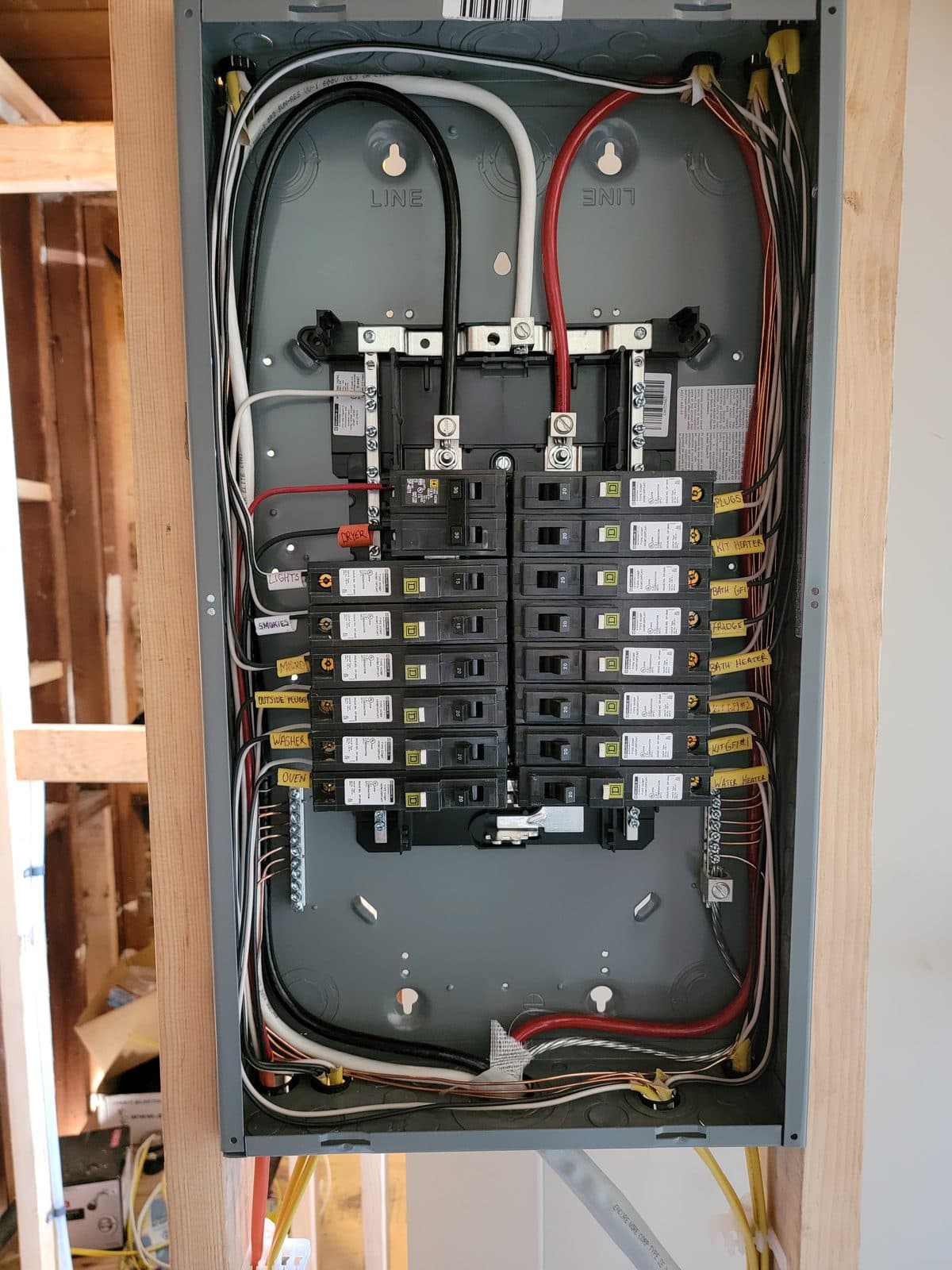
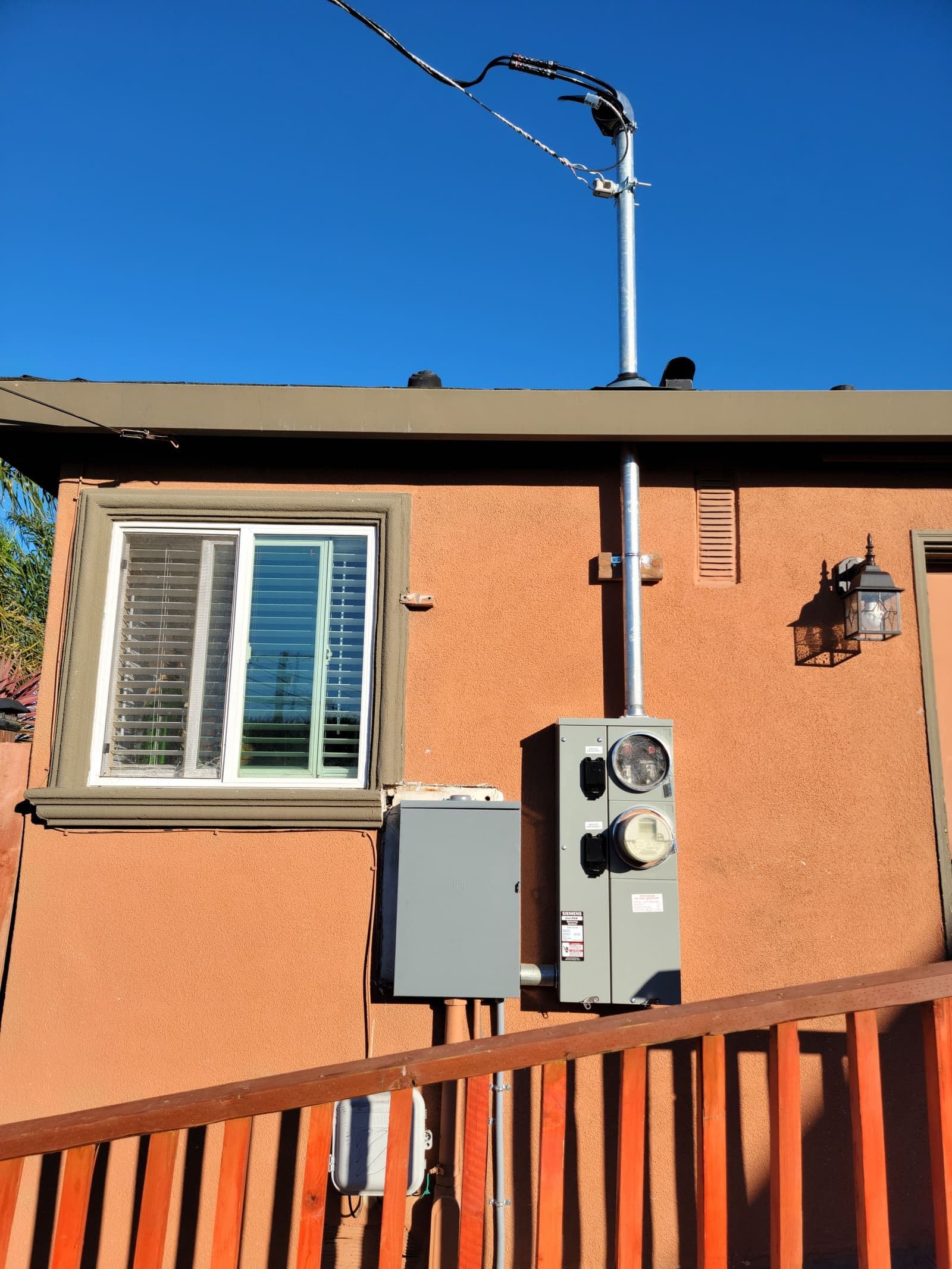
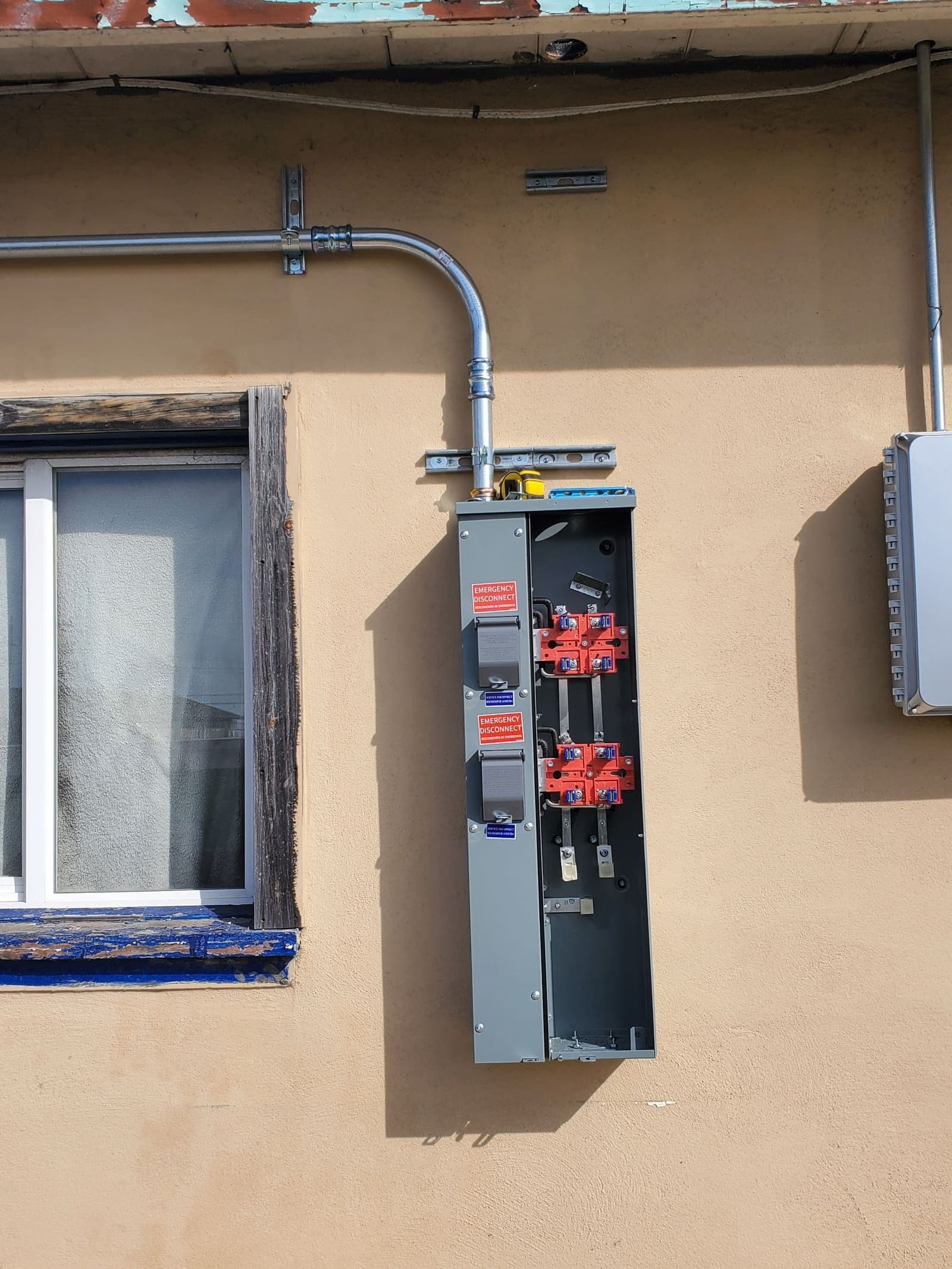
The full panel spectrum
Panel upgrade, replacement, repair, and more
“Panel upgrade” covers a range of work, and the right scope for your home depends on what your service can carry and the condition of the existing equipment. Our team handles every variation below across Santa Clara County, all permitted and inspected.
200A Panel Upgrade
The most common job: increasing service from 100A to 200A with a new meter base, service entrance, and panel. Adds headroom for EV charging, heat pumps, and subpanels. NEC 220.87 load calc confirms the need before we quote.
Panel Replacement (Same Amperage)
A like-for-like swap when the service capacity is already adequate but the panel is obsolete, overheating, rusted, or discontinued. New code-compliant enclosure, breakers, grounding, and labeling, without the cost of a full service upgrade.
Panel Repair (Breaker and Bus Bar)
Not every panel needs replacing. A failed breaker, a loose or burned bus-bar connection, a corroded neutral, or a bad lug can often be repaired on a serviceable panel. We diagnose first and recommend repair over replacement when it's the safe, code-compliant fix.
Subpanel Installation
A 60-100A subpanel feeds a garage, ADU, workshop, or addition without re-running every circuit to the main. Often the cleanest way to add capacity for an EV charger or shop equipment when the main panel has room on the bus.
400A Service Upgrade
For large or all-electric homes, multiple EV chargers, or a second dwelling on the same meter, a 400A meter-main with dual 200A panels carries loads a single 200A service can't. Requires closer PG&E coordination. We size to your actual calculated load, not guesswork.
Fuse Box and FPE/Zinsco Conversion
Old fuse boxes and hazardous Federal Pacific (Stab-Lok) or Zinsco panels get converted to a modern breaker panel, a fire-safety and insurance issue, not just a capacity one. See our FPE and Zinsco panel replacement page →
Utility and permit detail
Overhead vs underground service and PG&E coordination
How your home is fed changes the scope of a panel upgrade. An overhead service drops from a utility pole to a weatherhead and meter on an exterior wall, usually the simpler, lower-cost upgrade because the service entrance stays above ground. An underground service (common in newer Santa Clara County subdivisions) runs a lateral from a pad-mounted transformer or pull box to the meter; replacing or resizing that lateral, or converting overhead to underground, adds trenching, conduit, and a longer utility review.
Meter relocation is the single biggest cost driver. If the existing meter location no longer meets PG&E clearances or city code (or you want it moved for an addition or aesthetics), the service entrance, mast, and meter base all move with it, and the utility has to re-establish the connection point.
For a straightforward meter-stays-put upgrade, PG&E handles a same-day disconnect and a post-inspection reconnect. But meter relocations, 400A services, and overhead-to-underground conversions route through PG&E Building & Renovation Services, which reviews the service plan and can add several weeks before a shutoff can even be scheduled. Starting that application early is the difference between a two-week project and a two-month one. Our team files it, coordinates the field meeting, and pulls the permit with your city's building department so the utility and inspection steps line up.
Most of Santa Clara County is served by PG&E; the City of Santa Clara is served by Silicon Valley Power, and Palo Alto by CPAU. Each has its own reconnect process, and we handle whichever one applies to your address.
Utility reference: PG&E Building & Renovation Services ↗
Local and credentialed
Cali Rollin Electric
Serving Santa Clara County
Headquarters in Morgan Hill, CA 95037
Phone
408-614-4451What to budget
What drives panel upgrade cost
The largest cost variable is whether your meter and panel can stay in their current location. When the existing location is serviceable, a standard upgrade runs $7,000 to $9,000. Meter relocation, sometimes required by PG&E or city code, brings the range to $8,000 to $15,000.
The second variable is utility coordination. PG&E, SVP, and CPAU each have their own reconnect scheduling process. We handle all of it (permit filing, utility coordination, and inspection scheduling) so you don't make a single call outside of talking to us.
If you plan to add an EV charger or solar at the same time, we rough in those circuits on the same trip. One permit, one inspection, one utility shutoff day.
01
Free Load Assessment
NEC 220.87 load calculation, panel inspection, upgrade scope defined. No charge.
02
Written Quote and Permit Filing
Written itemized quote before any work. Permit filed with your city, typically 1–2 business days.
03
Upgrade Day
Utility shutoff coordinated, new meter base and service panel installed, circuits transferred. 4–8 hours.
04
Inspection and Reconnect
City inspection coordinated. Utility reconnect scheduled. Permit close documents delivered.
| Scope | Range |
|---|---|
| 100A to 200A Service Upgrade | $7,000 – $9,000 |
| 200A Service Upgrade (meter relocation required) | $8,000 – $15,000 |
| Exact Panel Replacement (same amperage) | $5,500 – $6,000 |
| Subpanel Replacement | $1,200 – $2,000 |
| Permits (standard swap) | $500 – $1,000 depending on jurisdiction |
Permits vary by city and typically add $500 to $1,000 depending on jurisdiction. A written quote is provided before any work begins.
A standalone panel upgrade does not carry its own rebate, but pairing it with an EV charger installation or a SPAN smart panel can unlock those devices' own incentive programs.
Why Cali Rollin Electric
What we bring to every panel upgrade
A panel upgrade involves a utility shutoff, a new meter base, and transferring every circuit in your home to a new service panel, all in a single day. Getting it wrong means a failed inspection, a callback, or a permit that never closes. Every permit pulled, every job inspected. Our team, with 15+ years in the trade, stays with you through the whole process: before the estimate, the day of the upgrade, and when the permit closes.
Permit pulled on every job
Every Santa Clara County city. No exceptions. Inspection documented.
Utility coordination handled
We coordinate the PG&E, SVP, or CPAU reconnect. You don't make the calls.
Load calculation included
NEC 220.87 load calc performed before quoting. No surprises day-of.
EV and solar ready wiring
Future circuits roughed in on request. One trip, not two.
All 15 cities served
Every incorporated city across Santa Clara County, one standard.
Same-day emergency response
Panel failures, tripped mains, utility shutoffs: we respond.
Related work
Not the right fit? Here is where to go next
FPE / Zinsco panel replacement
If your panel is a Federal Pacific or Zinsco, it should be replaced for safety before anything else.
EV charger installation
Adding a charger after the upgrade? We rough in the circuit and install it to code.
Emergency electrician
Panel failure, a tripped main that will not reset, or a burning smell? We respond fast.
All residential services
See the full Sanctuary lineup: panels, EV, rewires, generators, and more.
Serving homeowners across all 15 Santa Clara County cities.
Common questions
Panel upgrade: FAQ
How do I know if my home needs a panel upgrade?
A load calculation performed by our team determines this definitively, but several warning signs point to a likely need: breakers that trip frequently, lights that flicker when large appliances turn on, buzzing or burning smells near the panel, a panel rated at 100A or less, no open slots for new breakers, a hazardous panel brand like Federal Pacific or Zinsco, or plans to add major new loads like an EV charger or solar. Most homes built in the last 30 years with 200A service are in good shape. Homes built before the 1980s with original panels are the most likely to need an upgrade.
How much does a panel upgrade cost in Santa Clara County?
Panel upgrade costs at Cali Rollin Electric in Santa Clara County: a 100A to 200A service upgrade runs $7,000–$9,000. A 200A upgrade requiring meter relocation runs $8,000–$15,000. An exact panel replacement at the same amperage runs $5,500–$6,000. Subpanel replacement runs $1,200–$2,000. Permits vary by city and typically add $500–$1,000 depending on jurisdiction. All pricing is provided in a written quote after a full assessment: no surprises after the job starts.
How long does a panel upgrade take?
The physical work takes 4–8 hours for a standard residential panel swap. With a crew of two to three electricians, most jobs are completed in a single day. The full project timeline including permitting and inspection typically spans one to two weeks across Santa Clara County: permit approval takes 3–10 business days, installation takes 4–8 hours on-site, and final inspection is scheduled 1–3 days after installation.
Is a permit required for a panel upgrade in Santa Clara County?
Yes. Always. Every electrical panel upgrade, service entrance change, or meter-main replacement in Santa Clara County requires a permit. Skipping the permit can void your homeowner's insurance, create problems when selling or refinancing, and result in fines or code enforcement. Cali Rollin Electric handles the entire permit process on your behalf through your city's building department.
Will I be without power during the upgrade?
Yes, for approximately 4–8 hours on the day of installation. Power is shut off at the main breaker while the work is performed. Refrigerated food is generally fine for up to 4 hours if you keep the fridge closed. Charge devices and laptops before the scheduled outage day. Cali Rollin Electric coordinates the PG&E disconnect and reconnect scheduling so the outage window is as predictable and short as possible.
Do I need a panel upgrade before installing an EV charger?
Not always. It depends on a load calculation. A 200A panel with gas appliances and open slots typically does not need an upgrade. A 100A panel likely does. If an upgrade is needed alongside an EV charger install, Cali Rollin Electric offers panel upgrade as an add-on starting at $5,500–$8,000. Rather than assuming you need an upgrade, we run a load calculation during the free estimate to give you a precise answer. In many cases a smart EV charger with Dynamic Load Balancing can be installed without a panel upgrade.
What's the difference between a panel upgrade and a panel replacement?
A panel upgrade increases your service capacity, most commonly from 100 amps to 200 amps, and involves a new main breaker, panel, and often a new meter base and service entrance. A panel replacement is a same-amperage swap: the existing service stays at, say, 100A or 200A, but a damaged, obsolete, overheating, or hazardous panel (like Federal Pacific or Zinsco) is replaced with new code-compliant equipment. Replacement runs $5,500–$6,000 because the service capacity isn't changing; an upgrade runs $7,000–$9,000 because the heavier service entrance, larger conductors, and utility coordination add scope. During the free assessment, Cali Rollin Electric runs an NEC 220.87 load calculation to tell you which one your home actually needs. Many homes only need a replacement, not a full upgrade.
Do I need a 400A service, or is 200A enough?
For most single-family homes in Santa Clara County, 200A is plenty. It comfortably carries an EV charger, heat pump HVAC, induction cooking, and a subpanel. A 400A service is usually only warranted for large homes (roughly 4,000+ sq ft), homes adding multiple EV chargers, a large ADU or second dwelling unit on the same meter, or an all-electric conversion with high simultaneous demand. A 400A upgrade is a larger job. It typically requires a 400A meter-main, dual 200A panels or a 400A panel, larger underground or overhead conductors, and closer PG&E coordination. Cali Rollin Electric sizes the service to your actual NEC 220.87 calculated load rather than over-building, so you don't pay for capacity you'll never use.
How does PG&E coordination work for a panel upgrade in Santa Clara County?
Most of Santa Clara County is served by PG&E (the City of Santa Clara is served by Silicon Valley Power, and Palo Alto by CPAU). For a standard 100A-to-200A upgrade where the meter stays in place, PG&E performs a service disconnect on installation day and a reconnect after the city inspection passes. Cali Rollin Electric schedules both so your outage window stays short. When the work involves relocating the meter, increasing to a 400A service, or converting an overhead drop to an underground lateral, the project goes through PG&E's Building & Renovation Services group, which reviews the service plan and can add several weeks to the timeline. We file that application, coordinate the field meeting, and pull the city permit so the utility and inspection steps line up. You don't make a single call to PG&E. We manage the entire process.
Get started
Get a free panel upgrade assessment
Tell us about your panel and what you want to add. Our team responds the same day during business hours with an NEC 220.87 load assessment, not a guess. Most panel upgrades are completed in a single day, and there is no charge to find out what yours needs.