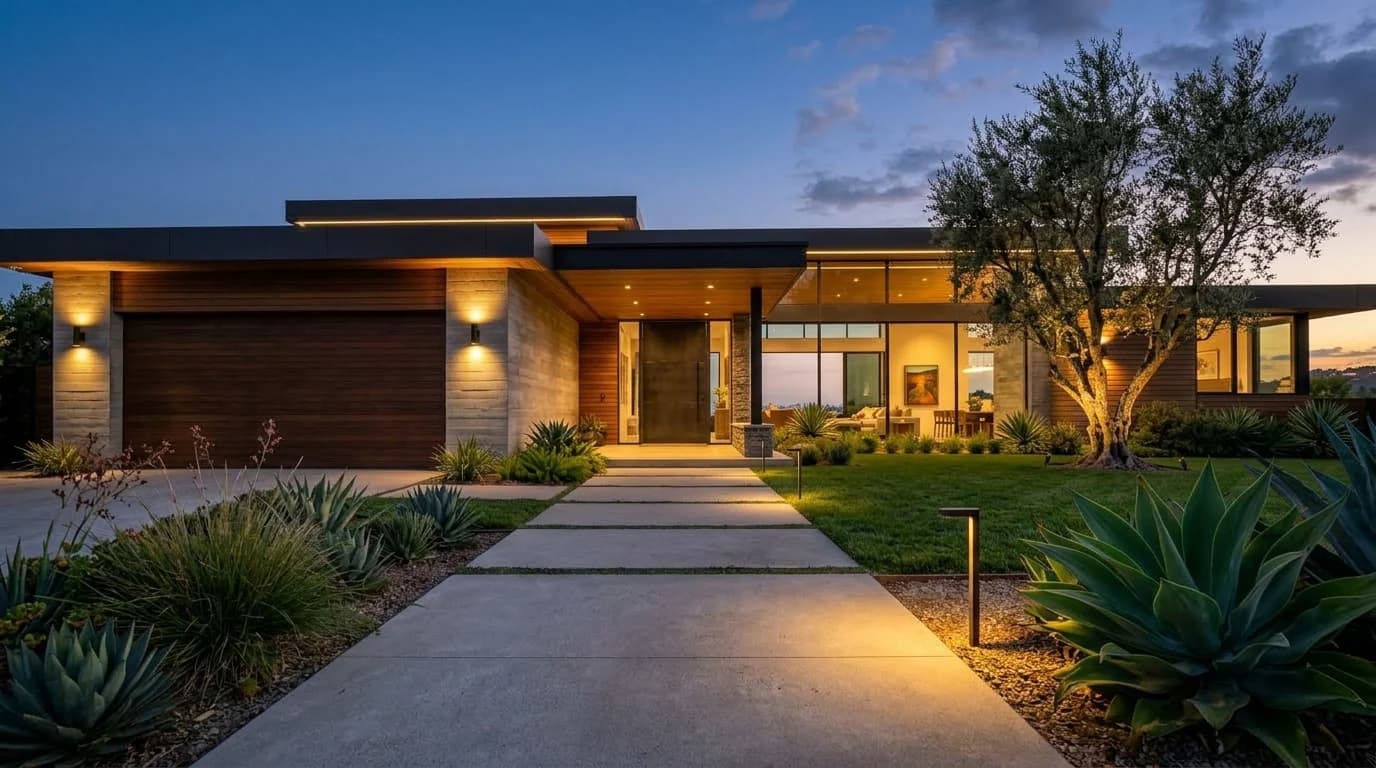
Outdoor and Landscape Lighting
Outdoor Lighting Installation in San Jose. Line Voltage and Low Voltage, Both Sides.
Our team designs and installs residential outdoor lighting across Santa Clara County: 120-volt architectural, security, soffit, post, and step lighting, plus listed 12-volt landscape systems with transformers, path lights, uplights, well lights, and controls. Permitted where a permit applies, and aimed after dark.
- Both voltage sides
- 120V + 12VBoth voltage sides
- Low-voltage code scope
- Article 411Low-voltage code scope
- Current code cycle
- 2025 CECCurrent code cycle
- Included on every install
- Night aimIncluded on every install
Quick answer
Line voltage vs low voltage
Which half of the job is which
This is the question almost every outdoor lighting project starts with, and the answer is usually “both, in different places.” Here is how the two sides actually differ.
| Factor | Line voltage (120V) | Low voltage (12V) |
|---|---|---|
| Typical fixtures | Wall packs, soffit and eave lights, post and column lights, step and in-wall lights, security floods | Path lights, uplights, well lights, hardscape and step strips, tree-mounted downlights |
| Power source | A dedicated 120V branch circuit from the panel | A listed transformer fed from a protected 120V outdoor circuit |
| Light output | Higher output per fixture, better for security and building washing | Lower output per fixture, better for layering, depth, and glare control |
| Buried wiring | Deeper cover, conduit or direct-burial cable to NEC Table 300.5(A) | Shallower cover permitted for a listed landscape system at 30V or less |
| Adding fixtures later | Requires a new run and often a new circuit | Easy if the transformer and cable were sized with headroom on day one |
| Best for | Entries, garages, driveways, house facades, security coverage | Planting beds, walkways, trees, patios, low walls, and seating areas |
Why one contractor matters
A low-voltage landscape system is only as good as the 120-volt circuit feeding its transformer. When one trade designs the yard and nobody owns the source, the result is a well-planned system plugged into an outlet that was never protected or covered for the weather.
What we cover
Both voltage sides
Panel, circuit, transformer, and fixtures as one design
From the field
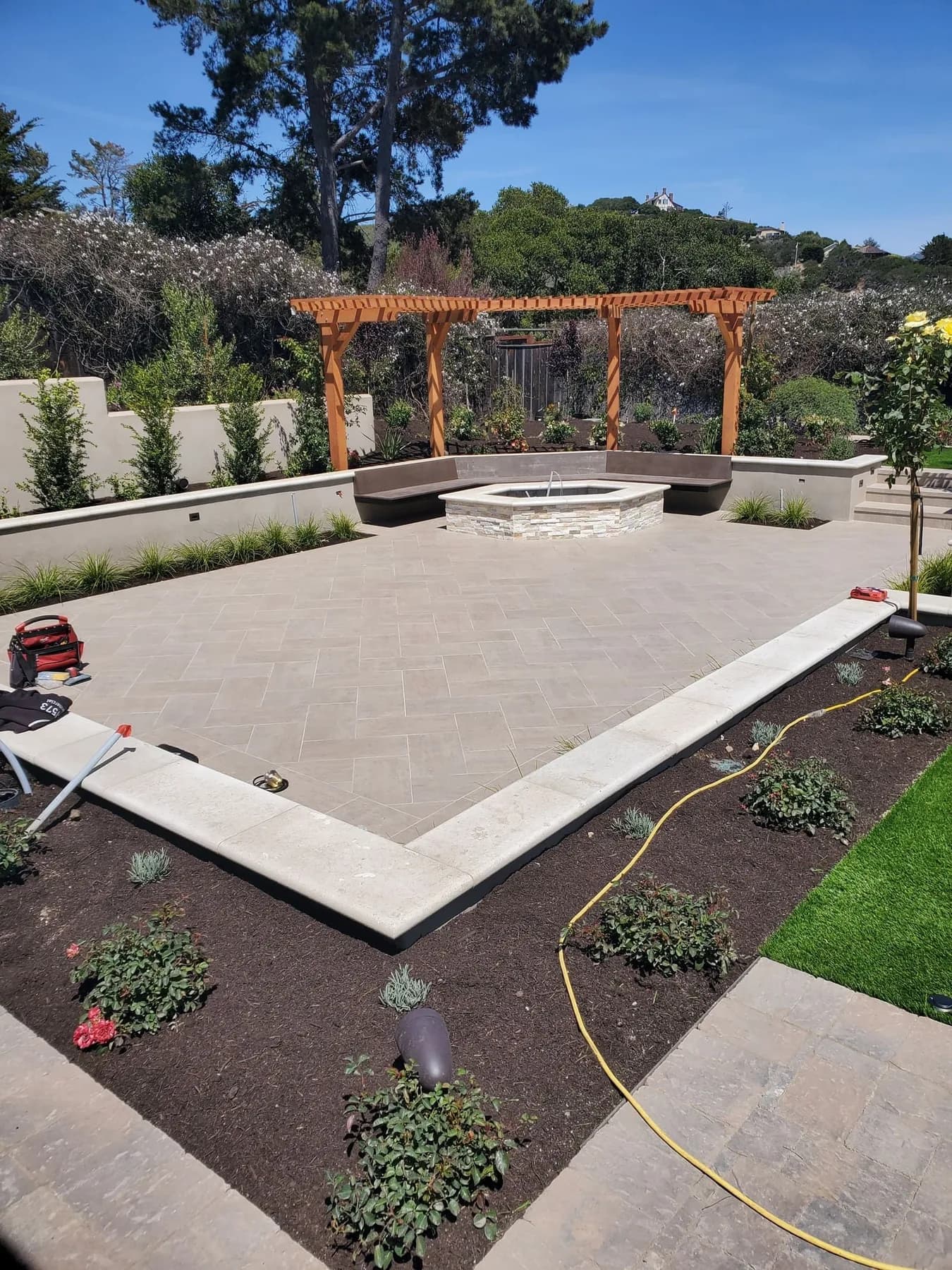
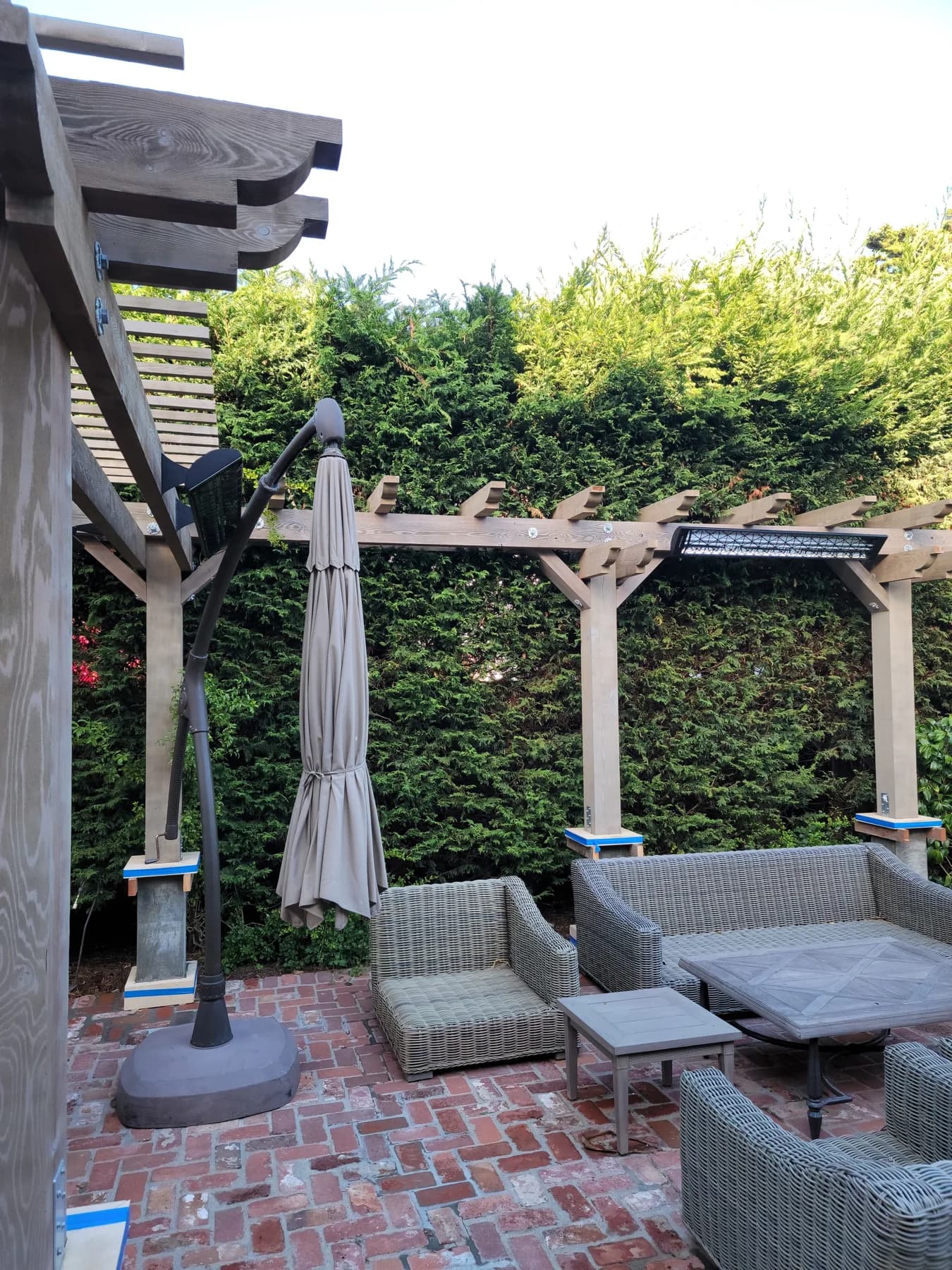
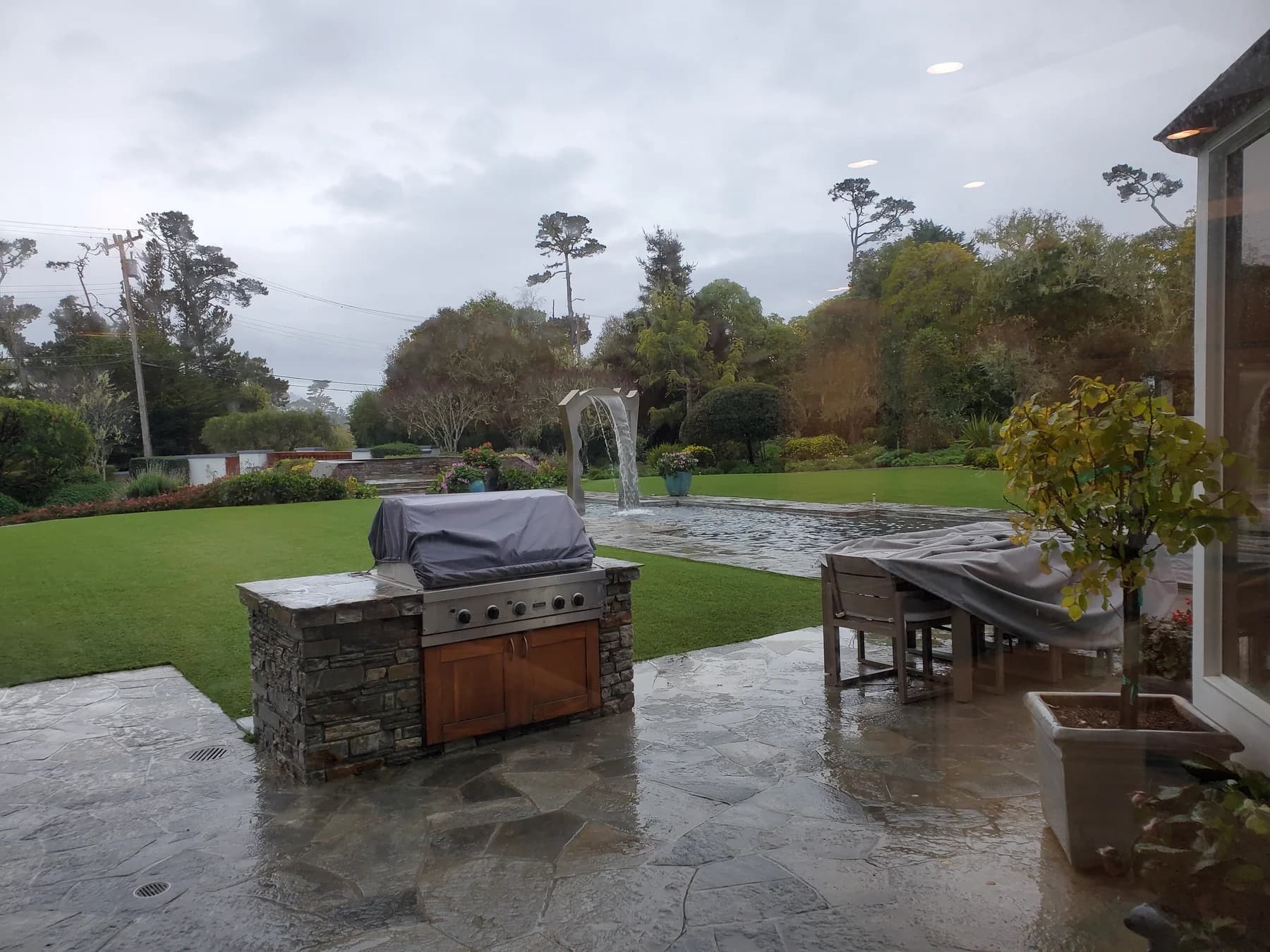
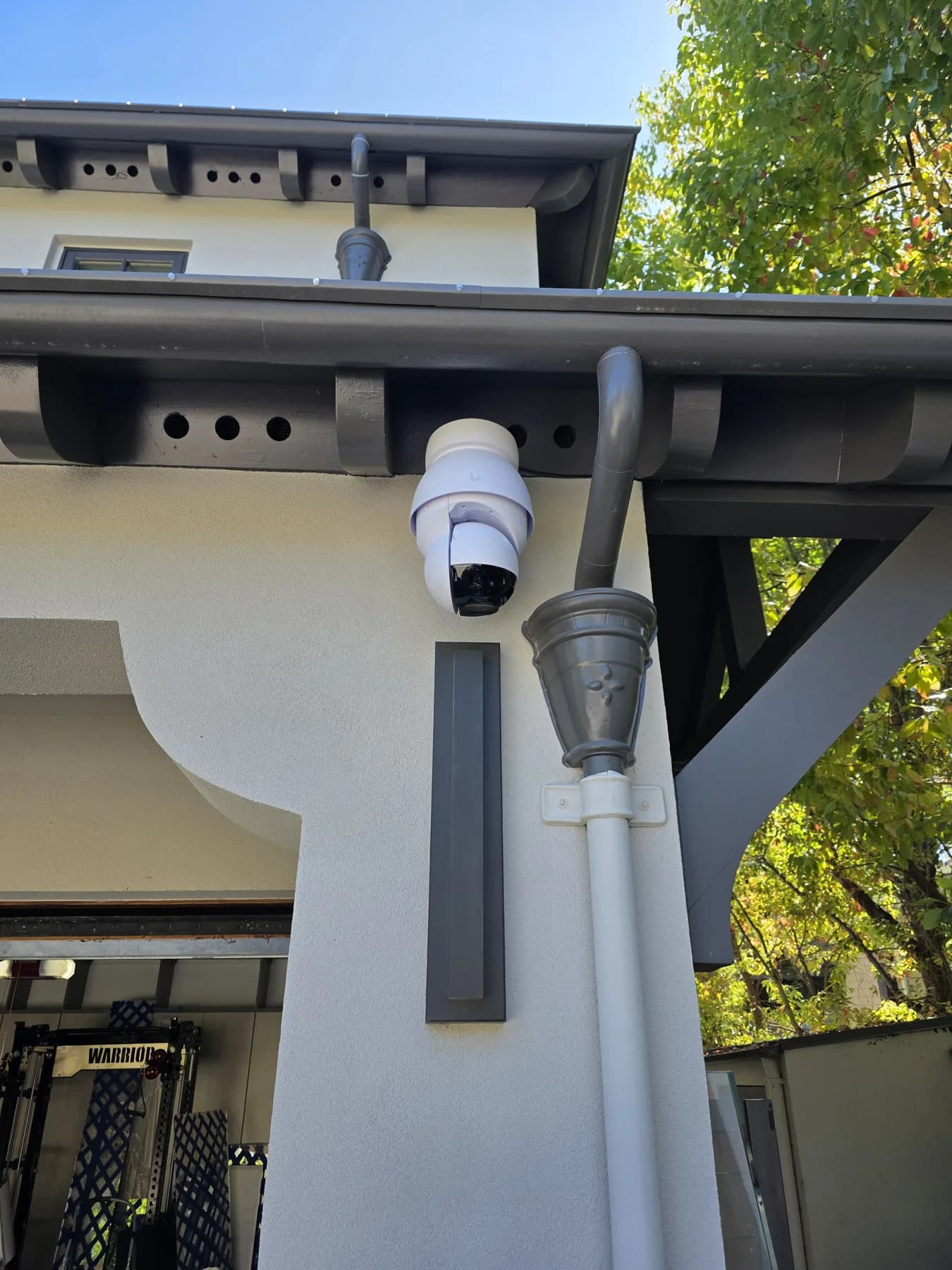
Outdoor lighting our crew has installed
Real jobs, not catalog renderings. Walkways, planting beds, and patios where the fixtures do the work and stay out of the way.


Line-voltage scope
120-volt outdoor lighting and circuits
Everything mounted to the house or fed directly from the panel. This is permitted electrical work, and it is the half most landscape crews are not licensed to touch.
Architectural and Facade Lighting
Soffit and eave downlights, column and gable accents, and grazing on stone or stucco. Fixtures under a covered eave are a damp location; anything exposed to weather is a wet location and gets a luminaire marked for it.
Security and Motion Lighting
Flood and area fixtures aimed at driveways, side yards, and back doors, wired with motion and photocell control so they earn their keep instead of running all night at full output.
Post, Column, and Entry Lights
Driveway and walkway post lights on a dedicated circuit, entry and garage-side fixtures, and address lighting. Trenched runs, sleeves under hardscape, and bases set so a post stays plumb for years.
Step, In-Wall, and Stair Lighting
Recessed in-wall and step fixtures at grade changes and stairs, roughed in with weatherproof boxes before finish work when we are on the job early enough to do it cleanly.
Exterior Receptacles and Circuits
The outdoor receptacles a project needs, in weather-resistant devices under a listed extra-duty in-use cover, on GFCI protection. This is the circuit a landscape transformer plugs into.
Panel Capacity for Exterior Loads
Older Santa Clara County homes often have no spare breaker space and no usable exterior circuit. We check that first so the lighting plan is not built on a panel that cannot carry it. See our panel upgrade page →
Low-voltage scope
12-volt landscape lighting systems
Listed systems built to last, not kits assembled from whatever was on the shelf. NEC Article 411 covers this work, and 411.3 caps operating voltage at 30 volts ac or 60 volts dc, dropping to 15 volts ac or 30 volts dc where wet contact is likely. It also requires the system to be listed as a complete system or assembled from listed parts, limits each secondary output circuit to 25 amperes, and prohibits installation within 10 feet of pools, spas, and fountains except under Article 680.
Complete Low-Voltage Systems
A listed system installed as a system: transformer, main runs, hubs, fixtures, and connectors chosen together. NEC Article 411 governs this work, and the assembly has to be listed as a complete system or built from listed parts.
Transformer Sizing and Placement
Our design practice is to load a transformer to roughly 80% of nameplate so there is headroom for fixtures you add later. Multi-tap transformers (12, 13, 14, and 15 volt taps) let us compensate for drop on long runs.
Path, Uplight, and Well Lighting
Path fixtures spaced to overlap softly instead of dotting a walkway, uplights aimed off the trunk line so glare stays out of sight lines, and in-grade well lights, which are always a wet location.
Hardscape, Step, and Wall Lighting
Linear fixtures under caps, treads, and seat walls, run so the light is visible and the fixture is not. This is the layer that makes a patio usable after dark without a single glaring source.
Controls and Scheduling
Photocells, astronomic time clocks, and app-driven controllers that follow sunset through the year instead of drifting a month out of sync every season.
Repair and System Rescue
Half the yard dark, a transformer that clicks off, dim fixtures at the far end of a run, corroded pierce-point connections. We take over systems someone else installed and bring them back.
Repair and rescue
Landscape lighting repair: half the yard is dark, start here
A large share of the outdoor lighting work our crew does is not a new install. It is a system somebody else put in three to eight years ago that has been going dark a section at a time, and the homeowner has already replaced bulbs twice without fixing anything. We take on landscape lighting repair for systems we did not install, including big-box kits and systems left behind by a landscape crew that has long since moved on.
Low voltage landscape lighting repair starts with a meter, not a parts order. We measure voltage at the transformer output, at the first fixture, and at the last fixture on each run. That single set of readings separates a transformer problem from a cable problem from a connection problem, and it usually puts us on the fault during the first visit. Everything below is what we check, in the order we check it.
Transformer output and taps
The first reading of the visit. We confirm the unit is energized, measure what each tap is putting out under load, and check whether the internal breaker or thermal cutout has been shutting it down every night. A transformer that clicks off an hour after dusk is usually overloaded, not dead.
The GFCI on the source receptacle
The 120-volt receptacle feeding the transformer is the most common single reason an entire system goes dark, and it is the fastest thing to rule out. A tripped GFCI, a tripped device upstream of it, or water sitting inside a cover that was never listed extra-duty kills everything downstream.
Failed pierce-point connectors
Clamp-on connectors from a big-box kit puncture the cable jacket and leave bare copper in wet soil. They are the failure we find most often on systems three to eight years old. Every one we open gets rebuilt as a gel-filled or heat-shrink connection instead.
Corroded sockets and fixture leads
One dark fixture with healthy neighbors is usually a corroded socket, a failed LED module, or a lead that wicked water up into the fixture body. We test at the lead before condemning the fixture, because plenty of them are fine once the connection is rebuilt.
Voltage drop at the end of a run
Fixtures that fade progressively toward the far end of a run are voltage drop or undersized cable, not failed lamps. We meter at the transformer, the first fixture, and the last fixture on every run, which is the reading that tells us whether to change the tap, the cable, or the layout.
Water in a fixture and cut cable
In-grade well lights fill with water once the gasket or the drainage beneath them gives up. Buried cable gets cut by a shovel, an aerator, or a fence post. Both show up as a section that died all at once, and both get found by tracing the run rather than guessing at it.
Landscape lighting transformer repair is its own decision. Sometimes the cause is a tripped internal breaker, a failed photocell or timer module, or a corroded terminal block, and the unit is worth saving. Sometimes the transformer was undersized on day one and has been running at or past its nameplate for six hours a night for years, and repairing it only buys another season. We tell you which of those two you have, and when a replacement is the honest answer we size it with headroom so the next two fixtures you add do not put it right back over the line.
From there the repair is scoped plainly. Sometimes it is a single corroded connector. Sometimes it is a length of undersized cable that is not worth saving. And sometimes the system is electrically fine and only needs re-aiming, because fixtures shift as plants grow around them and a yard that looks dead is often a yard where every uplight is now pointing into a shrub. Our team is equally willing to give you that answer.
The part nobody photographs
The 120-volt source is the real job
California is on the 2025 California Electrical Code (Title 24, Part 3), based on NEC 2023, effective January 1, 2026. Three requirements shape almost every outdoor lighting job under it, and none of them are visible in a finished photo.
GFCI protection, correctly scoped. NEC 210.8(F) requires GFCI protection for outdoor outlets at a dwelling, and Exception 1 exempts lighting outlets. In plain terms: a hardwired outdoor luminaire is a lighting outlet and is exempt, but the outdoor receptacle your landscape transformer plugs into is not, and it needs GFCI protection. There is also a replacement trigger, so when equipment supplied by one of those outlets gets replaced, the protection has to be added. Anyone telling you every outdoor light must be GFCI protected has the rule backwards.
Wet and damp location listing. NEC 410.10(A) requires luminaires in wet locations to be marked “Suitable for Wet Locations,” and damp locations to be marked either wet or damp. Because 410.10(A) accepts either marking in a damp location, a wet-rated fixture can serve a damp location, but never the reverse. In practice: an in-grade well light is a wet location, always. A fixture tucked under an eave or on a covered porch is a damp location. Using an indoor or damp-only fixture in a wet spot is the most common thing we find on failed installs.
Extra-duty in-use covers. NEC 406.9 requires 15- and 20-amp receptacles in wet locations to have an enclosure that stays weatherproof whether or not a plug is inserted, and the hood has to be listed and identified as extra-duty. Receptacles in damp and wet locations also have to be listed weather-resistant. A flip-up cover that only closes when nothing is plugged in does not satisfy this, and it is exactly where a permanently plugged-in transformer lives.
Older Santa Clara County homes frequently have no spare breaker space and no usable exterior circuit at all. When that is the case, the lighting design waits until the source is sorted out, because building a system on a panel that cannot carry it is how a project turns into two projects.
Local and credentialed
Cali Rollin Electric
Serving Santa Clara County
Headquarters in Morgan Hill, CA 95037
Phone
408-614-4451Burial cover
How deep the cable actually has to go
NEC Table 300.5(A) sets minimum cover by wiring method and voltage. The number that surprises people most is the last one: cover is measured to soil grade, not to the top of the mulch or gravel spread over it. Mulch settles and gets raked, so a run measured from the bark surface is shallow within a season.
| Wiring method | Minimum cover |
|---|---|
| Direct-burial cable (120V, Type UF) | 24 inches |
| Rigid metal or intermediate metal conduit | 6 inches |
| PVC conduit or EMT | 18 inches |
| Residential branch circuit, 120V or less, GFCI protected, 20A max breaker | 12 inches |
| Landscape lighting, 30V or less, Type UF or identified cable | 6 inches |
| Landscape lighting, 30V or less, under a residential driveway | 18 inches |
A listed low-voltage lighting system's own installation instructions may permit less cover than the table, and where they do, we follow the listing. What we do not do is bury a run shallow because it was faster and hope the gardener never digs there.
Year three
Why outdoor lighting systems fail, and how we build against it
A landscape lighting system almost never fails on install day. It fails two or three seasons later, and when it does, it is usually one of these six things. Every one of them is a decision made during installation.
Voltage drop nobody accounted for
Low-voltage cable loses voltage over distance. Our design practice targets every fixture within about 10% of nominal, roughly 11 to 15 volts on a 12-volt system. Below that, LED output falls off and color shifts, and the far end of the run looks dead long before it is.
Pierce-point connectors instead of waterproof ones
The clamp-on connector that comes in a big-box kit punctures the jacket and leaves bare copper in wet soil. It works for a season or two, then corrodes. Waterproof, gel-filled or heat-shrink connections are the difference between year three and year thirteen.
Undersized cable and daisy chains
Running every fixture in one long series guarantees the last one is starved. Hub-and-spoke or split runs with cable sized for the load keep the whole system even instead of bright at the house and dim at the fence.
A transformer loaded to the limit
A transformer running at or above its nameplate has nothing left for the two fixtures added next spring, and it runs hot. Article 411 also caps a secondary output circuit at 25 amperes, which is a hard ceiling, not a guideline.
Cable buried to the top of the mulch
Burial cover is measured to soil grade, not to the top of the bark or gravel that was spread over it. Mulch settles and gets raked. A run that measured deep enough on install day is shallow by the second season if the mulch was counted.
A transformer on an unprotected receptacle
The outdoor receptacle a transformer plugs into needs GFCI protection, a weather-resistant device, and a listed extra-duty in-use cover that stays weatherproof with the plug inserted. A standard interior-grade setup outdoors is how water finds the connection.
Design practice
Transformer sizing and voltage drop
Transformer sizing and voltage-drop targets are trade practice, not code. These are the rules our team designs to, and we are naming them as ours rather than dressing them up as a requirement.
We size a transformer so the connected load sits at roughly 80% of nameplate. That leaves headroom for the fixtures you will want next spring and keeps the unit from running hot at full load for six hours a night. We then target every fixture within about 10% of nominal, roughly 11 to 15 volts on a 12-volt system. Below that window, LED output drops off and color starts to shift, which is why the far end of a poorly designed run looks yellow and weak while the first three fixtures look fine.
Multi-tap transformers, with 12, 13, 14, and 15 volt taps, are the practical tool for this. A long run lands on a higher tap so the drop across the cable brings it back into range at the fixture. Two limits here are hard rather than preference: each secondary output circuit is limited to 25 amperes under Article 411, and the 15-volt tap is the listing ceiling for these systems under UL 1838. Nothing we do goes past either one.
We measure at the transformer, at the first fixture, and at the last fixture on every run before we call a system finished. If the numbers are not in the window, the cable or the tap changes, not the expectations.
2025 California Energy Code
Controls required for building-mounted outdoor lighting
This is the requirement almost nobody in the outdoor lighting market talks about, and it is enforceable today. Title 24, Part 6, section 150.0(k)3 of the 2025 California Energy Code, effective January 1, 2026, governs residential outdoor lighting that is permanently mounted to the house or another building on the lot.
Those fixtures need a manual on and off switch, plus one of the following:
- a photocell paired with a motion sensor,
- a photocell paired with an automatic time switch, or
- an astronomical time clock.
Where a control offers an override to on, it has to return automatically within six hours. On an alteration, only the lighting being altered has to comply, and there is no like-for-like exemption that lets an old control stay just because the new fixture matches the old one.
The carve-out is the part worth knowing. Outdoor lighting that is not permanently attached to a building, in the words of the 2025 Single-Family Residential Compliance Manual, “such as decorative landscape lighting, is not regulated.” So the path lights and uplights out in the yard are a free design choice, while the soffit lights, wall packs, and post lights attached to the structure are not.
One more detail that gets misapplied: JA8 certification is not required for LED light sources installed outdoors, under Exception 4. The controls requirement still applies regardless.
Which side is your fixture on?
Attached to a building
Controls required
Soffit, eave, wall, entry, and post lights mounted to the structure
Out in the yard
Not regulated
Decorative landscape lighting: path, uplight, well, and hardscape fixtures
We wire and set the controls either way, because a system on an astronomic clock stays correct through the whole year instead of drifting with the seasons.
Good-neighbor practice
Light trespass, shielding, and color temperature
Straight answer first: there is no residential dark-sky ordinance, color-temperature cap, curfew, or property-line light limit in San Jose, Morgan Hill, Gilroy, or unincorporated Santa Clara County. If a contractor tells you the county forces shielded fixtures on homes, that is not accurate, and it is worth knowing before somebody sells you a fixture package on that basis.
Two cities do have quantified residential limits, and they are real:
- Palo Alto (PAMC 18.40.250): 0.1 footcandle at the property line, an 11 p.m. residential curfew, and a 2700K color-temperature cap.
- Cupertino (CMC 19.102.040): 0.1 footcandle at the property line, an 11 p.m. curfew, and a 3000K cap.
- Morgan Hill (MHMC 18.76.060) has a citywide glare rule rather than a footcandle limit: no direct or sky-reflected glare visible at 500 feet.
Everywhere else it is courtesy, and we design to it anyway. Shielded and hooded fixtures so the source is not visible from a neighbor's window. Warm color temperature, which also just looks better on stucco, stone, and planting. Uplights aimed tight to the trunk or the wall they are lighting instead of spraying past it. Fixtures aimed away from property lines and away from the street. Lighting that annoys the neighbors is lighting that gets turned off, which makes it wasted money regardless of what any ordinance says.
How the job runs
From site walk to night aim
01
Evening Site Walk
We look at the property after dark, because that is the only time you can see what is actually missing. Panel and exterior circuit capacity checked the same visit.
02
Layout and Written Quote
Fixture locations, transformer size and placement, cable routing, and control strategy, written out and priced before anything is dug or drilled.
03
Install
Trenching and sleeves, circuit work at the panel, transformer set and terminated, fixtures placed and connected with waterproof connections.
04
Night Aim and Handoff
We come back after dark to aim, shield, and adjust tap voltages, then walk you through the controls. Aiming in daylight is guesswork.
We do not publish a per-fixture price for outdoor lighting, because the honest range is too wide to be useful. Fixture count and quality, run lengths, whether trenching crosses hardscape or needs sleeving, panel and exterior circuit capacity, and how much of the scope is permitted line-voltage work all move the number substantially. You get a written itemized quote after the site walk, before anything starts.
Where permitted electrical work is part of the scope, residential permits and inspection typically add $500 to $1,000 depending on jurisdiction, and our team pulls and closes the permit.
There is no active utility incentive covering residential outdoor lighting in our service area, so we sell this work on what it actually delivers: operating cost, lamp life, safety at grade changes, and security coverage where it matters.
Why Cali Rollin Electric
What a landscape lighting electrician brings to the job
Outdoor lighting sits on a line most contractors only cover one side of. Landscape crews own the layout and the 12-volt fixtures. Electricians own the circuit, the weatherproofing, and the panel. Our team, with 15+ years in the trade, does both, which means the transformer, the receptacle feeding it, the controls, and the fixtures all get designed as one system instead of handed off halfway. That is the practical difference between hiring a fixture installer and hiring a landscape lighting electrician: when the fault turns out to be on the 120-volt side, nobody has to call a second trade to finish the job.
Both voltage sides, one contractor
Line-voltage circuits and listed low-voltage systems, designed together instead of bolted onto each other.
The 120V source done right
GFCI protection, weather-resistant devices, and a listed extra-duty in-use cover on every exterior receptacle we install.
Permitted and inspected
New exterior circuits are permitted work. We pull it and coordinate the inspection.
Title 24 controls handled
Building-mounted outdoor lighting gets the controls the 2025 California Energy Code requires, wired and set.
We return after dark
A night aiming visit is part of the job, not an extra. Fixtures get shielded and aimed when you can see the result.
Rescue work welcome
We take over failing systems others installed, diagnose the real cause, and rebuild the weak points.
Related work
Not the right fit? Here is where to go next
Panel upgrade
No spare breaker space and no usable exterior circuit is the most common blocker on an older home. Fix the source first.
EV charger installation
Adding a charger in the same trip? One trench, one permit, one crew instead of two mobilizations.
ADU electrical
Lighting a path, entry, and address for a new accessory dwelling unit, plus the subpanel and meter path behind it.
All residential services
The full Sanctuary lineup: panels, EV charging, rewires, generators, battery storage, and more.
Lighting a commercial property, a parking lot, or a shared lot instead of a home? Go to our parking lot and site lighting page →
Serving homeowners across all 15 Santa Clara County cities.
Common questions
Outdoor lighting: FAQ
What is the difference between low-voltage and line-voltage outdoor lighting, and which do I need?
Line-voltage lighting runs at 120 volts on a branch circuit straight from your panel, and it covers the fixtures attached to the house: soffit and eave lights, wall packs, security floods, post and column lights, and step or in-wall fixtures. Low-voltage landscape lighting runs at 12 volts through a listed transformer, and it covers the fixtures out in the yard: path lights, uplights, well lights, and hardscape strips. Most properties end up with both. Building-mounted lighting is generally line voltage because it needs output and it is already at a wall with a circuit nearby, while planting beds and walkways are almost always low voltage because the shallower burial rules and lower output suit them. Our team installs both, so the recommendation is based on what the property needs rather than on which half we are equipped to do.
Can you add to an existing landscape lighting system?
Usually yes, and the first thing we check is whether the existing transformer has capacity left. Our design practice is to load a transformer to roughly 80% of its nameplate rating, so a system already running near its limit needs either a larger transformer or a second one before fixtures get added. The second check is voltage at the end of the existing runs. If the far fixtures are already dim, adding more to the same run will make it worse, and the fix is new cable or a hub rather than another splice. We measure both before quoting so the addition does not degrade the system you already have.
Do I need a permit for outdoor lighting in San Jose?
It depends on the scope. Adding a new 120-volt branch circuit, a new exterior receptacle, or new building-mounted line-voltage fixtures is permitted electrical work in San Jose and across Santa Clara County. Plugging a listed low-voltage transformer into an existing, properly protected exterior receptacle and running 12-volt cable to landscape fixtures is generally not the same trigger, though the exterior receptacle itself has to be code compliant. When a permit applies, residential electrical permits and inspection typically run $500 to $1,000 depending on jurisdiction, and our team pulls the permit and coordinates the inspection as part of the job. We tell you up front which side of that line your project falls on.
Does my landscape lighting transformer need its own GFCI outlet?
The receptacle a transformer plugs into does need GFCI protection. This is a detail that catches people out, because a hardwired outdoor light fixture itself is exempt: NEC 210.8(F) requires GFCI protection for outdoor outlets at a dwelling, and Exception 1 carves out lighting outlets. A receptacle is not a lighting outlet, so a transformer plugged into an outdoor receptacle sits squarely in the part that needs protection. That receptacle should also be a weather-resistant device under a listed extra-duty in-use cover, which is the cover that stays weatherproof with the plug inserted, per NEC 406.9. There is also a replacement trigger: when equipment supplied by one of these outlets is replaced, GFCI protection has to be added. If your transformer is on an old unprotected receptacle, that is the first thing we correct.
Half my landscape lights stopped working. What is wrong?
When a whole section goes dark at once, the usual causes are a transformer that has tripped or shut down on overload, a failed connection at a hub or splice, or a cable cut by a shovel or an aerator. When fixtures go dim gradually from one end of a run to the other, it is almost always voltage drop or corroded connections rather than failed fixtures. Pierce-point connectors are the single most common failure we find: they puncture the cable jacket and leave copper exposed in wet soil, and after a couple of seasons the connection corrodes away. Our diagnostic is to measure voltage at the transformer, at the first fixture, and at the last fixture on each run, which usually isolates the problem in the first visit. Replacing bulbs before that measurement is taken is how people spend money without fixing anything.
How do I find landscape lighting repair near me in Santa Clara County?
Before you call anyone, check the two things that take five minutes and account for a surprising share of dark systems. First, the outdoor receptacle feeding the transformer: if its GFCI has tripped, or a GFCI upstream of it has, the whole system is dead and nothing else is wrong. Second, the transformer's own timer or photocell, which drifts out of sync with sunset over a season and can leave a system trying to run at the wrong hour. If both look right and a section is still dark, it is a wiring or connection fault and it needs a meter. Cali Rollin Electric works out of a shop in Morgan Hill, roughly 20 miles south of downtown San Jose, and our crew covers all 15 Santa Clara County cities, so a repair visit is a routine service call rather than a special trip. What we diagnose on that visit: transformer output and tap voltages, protection and weatherproofing at the source receptacle, failed pierce-point connectors, corroded sockets and fixture leads, voltage drop at the far end of a run, water inside an in-grade fixture, and cable cut by a shovel or an aerator. We repair systems we did not install, including big-box kits and systems a landscape crew left behind, and we will tell you plainly when a run or a transformer is not worth saving. Call 408-614-4451, describe what went dark and when it started, and our team will tell you what to expect before anyone comes out.
Why do budget outdoor lighting systems fail after a few years?
Five reasons, and they compound. Cable is undersized for the run length, so voltage drop starves the far fixtures. Everything is daisy chained in one series instead of split into hubs, which makes the drop worse. Pierce-point connectors let water into the copper. The transformer is loaded to its limit with nothing left over, so it runs hot. And the cable is buried to the top of the mulch rather than to soil grade, so it is effectively at the surface once the mulch settles or gets raked. None of those show up in the first season, which is why a system can look fine at handoff and be half dead by year three. Building it right costs more once and less over ten years.
Should outdoor lights run all night, and what controls do you install?
Most homeowners want the architectural and path lighting on from dusk until bedtime, and security lighting on motion only. For lighting permanently mounted to the house or another building on the lot, the 2025 California Energy Code (Title 24, Part 6, section 150.0(k)3) settles part of it for you: those fixtures need a manual on and off switch plus either a photocell paired with a motion sensor, a photocell paired with an automatic time switch, or an astronomical time clock. If a control has an override to on, it has to return automatically within six hours. Landscape lighting that is not permanently attached to a building is not regulated by that section, so a decorative path or uplight system in the yard is a free choice. In practice we install an astronomic time clock or a photocell-plus-schedule controller so the system follows sunset through the year instead of drifting a month out of sync every season.
Can a landscaper install my outdoor lighting, or do I need a licensed electrician?
The 120-volt side is licensed electrical work. A new exterior branch circuit, a new outdoor receptacle for a transformer, building-mounted line-voltage fixtures, and any work inside the panel all fall under a C-10 electrical contractor license and are permitted work. The 12-volt side is often installed by landscape contractors, and plenty of them do good work on layout and placement, but it is still governed by NEC Article 411 and it still depends on a properly protected 120-volt source that has to be installed correctly by someone licensed to do it. That is the practical split we see most often: a beautiful low-voltage layout plugged into an exterior receptacle that was never protected or covered properly. Because our team does both sides, the source and the system get designed together.
What does outdoor lighting cost?
We do not publish a per-fixture or flat price, because the honest range on this work is wide and driven by things nobody can see from a photo. The variables are fixture count and quality, how far the runs are from the transformer, whether trenching crosses hardscape or requires sleeves, whether your panel has capacity and a usable exterior circuit, and whether any of the scope is permitted line-voltage work. A small path lighting system on an existing protected receptacle and a full facade, security, and landscape package on a new circuit are different projects by an order of magnitude. Our approach is an evening site walk, a layout, and a written itemized quote before anything starts. When permitted electrical work is part of the scope, permits and inspection typically add $500 to $1,000 depending on jurisdiction.
Will the lights bother my neighbors?
Not if the system is aimed and shielded properly, and that is a design decision rather than a code one in most of the county. There is no residential dark-sky ordinance, color-temperature cap, curfew, or property-line light limit in San Jose, Morgan Hill, Gilroy, or unincorporated Santa Clara County. Morgan Hill does have a citywide glare rule (MHMC 18.76.060) prohibiting direct or sky-reflected glare visible at 500 feet. Two cities have quantified residential limits: Palo Alto (PAMC 18.40.250) caps light at 0.1 footcandle at the property line with an 11 p.m. residential curfew and a 2700K color-temperature limit, and Cupertino (CMC 19.102.040) uses 0.1 footcandle, an 11 p.m. curfew, and a 3000K limit. Everywhere else, we treat good-neighbor practice as the standard anyway: shielded fixtures, warm color temperature, aiming away from property lines, and no uplight spilling past the tree it is lighting.
Get started
Book an evening outdoor lighting walk
Tell us what you want lit and what is already there. Our team responds the same day during business hours and schedules the walk after dark, because that is the only time you can see what the property is actually missing. New systems, additions to an existing system, and rescue work all start the same way.