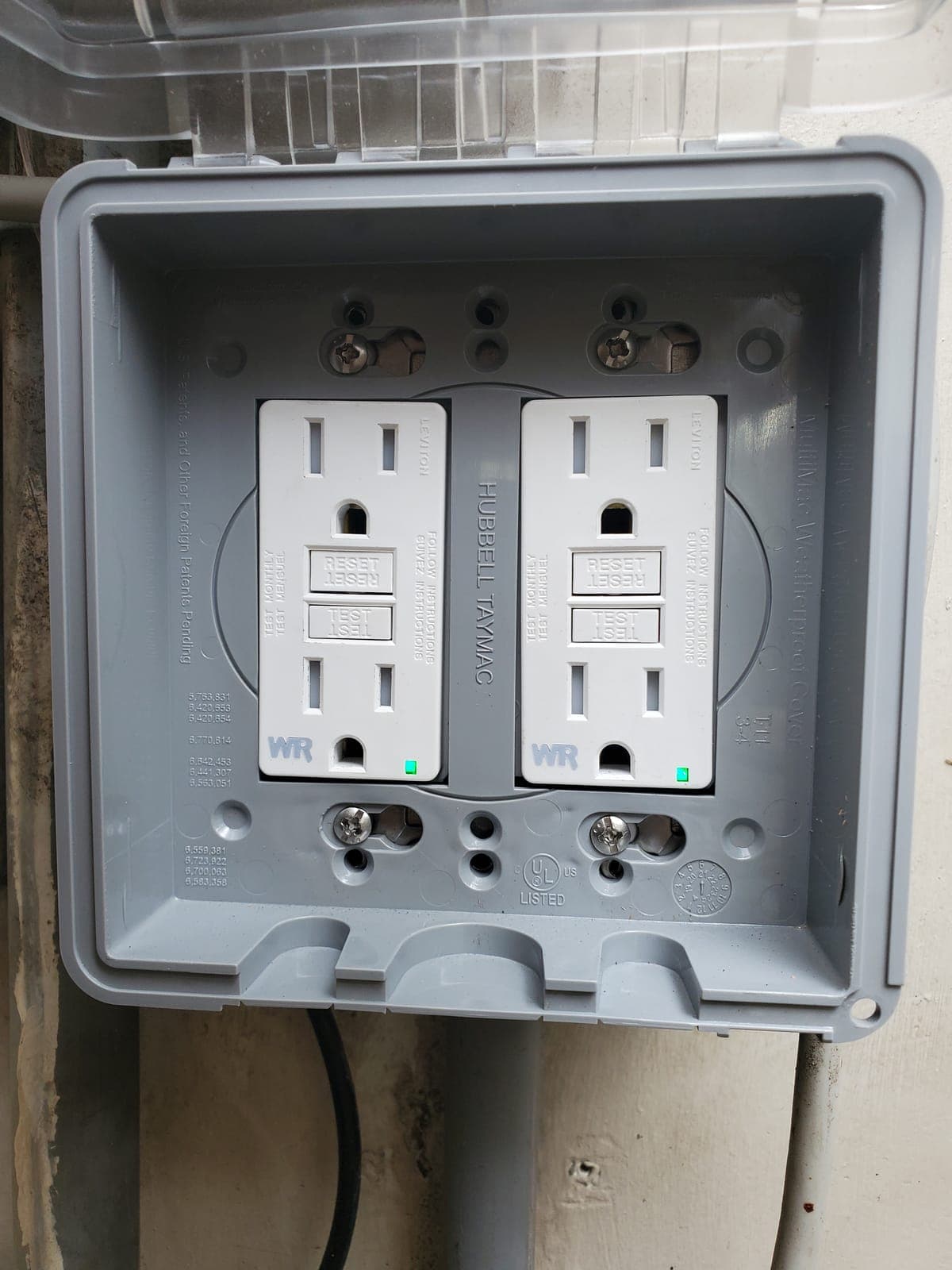
What a GFCI is actually doing
A GFCI (ground fault circuit interrupter) is the outlet with the TEST and RESET buttons, usually in your bathrooms, kitchen, garage, laundry, and outdoors. It watches the electricity flowing out and coming back, and the instant it senses even a tiny amount leaking somewhere it should not go (through water, a damaged cord, or a person), it cuts power in a fraction of a second.
So a GFCI that has tripped is doing its job. The question is whether it tripped for a simple reason you can clear yourself, or because there is a fault worth taking seriously.
Which of the four causes is yours
A GFCI that will not reset almost always comes down to one of four things. Two you can usually clear yourself in a few minutes. Two mean it is time to stop and let our team take over. Work the check below, or read the same logic in the table under it.
Narrow it down in three taps
Step 1 of 2When you press RESET, what happens?
Stop at any point and call us if you notice a burning smell, scorch marks, a warm faceplate, buzzing, or water at the outlet. This is a starting point, not a diagnosis. Our team confirms the actual cause on site.
| What you see | Likely cause | Who handles it |
|---|---|---|
| It clicks, then pops back out, with things still plugged in | A failing appliance or a wet cord is faulting the moment power returns | You can clear this |
| Nothing happens, and you find a tripped breaker or another tripped GFCI | The outlet has no power, or an upstream GFCI is protecting it | You can clear this |
| It clicks and pops back out with everything unplugged | A real ground fault in the wiring, often moisture in an outdoor or garage box | Our team |
| Nothing happens, breaker is on, no other GFCI is tripped | A worn-out GFCI (roughly ten to fifteen years), or reversed line and load wiring | Our team |
The four safe steps to try yourself
You can do all of these without opening anything or touching any wiring. If at any point you notice a burning smell, a warm or discolored faceplate, buzzing, or scorch marks, skip straight to the warning signs below.
Reset it properly
Press TEST first (you should hear a click), then press RESET firmly until it clicks and stays in. A half-pressed reset will not hold.
Check the breaker for that area
Open your electrical panel and look for a breaker flipped to the middle or to OFF. Push it fully OFF, then back ON. If the GFCI has no power, it cannot reset.
Look for another tripped GFCI
One GFCI often protects several regular outlets downstream. A dead bathroom outlet is frequently caused by a tripped GFCI in a different bathroom, the garage, or an exterior wall. Find and reset that one.
Unplug everything, then reset
A failing appliance or a wet cord can trip the GFCI the instant it resets. Unplug everything the outlet feeds, reset again, and if it holds, plug items back in one at a time until the culprit reveals itself.
If the GFCI resets and holds after those steps, you are done, and you just saved a service call.
When it still will not hold
If you have power to the outlet, nothing is plugged in, and it still will not hold, one of three things is usually true.
There is a real ground fault in the wiring
Moisture in an outdoor or garage box after rain is a common one. The GFCI is refusing to restore power because it is still sensing a leak.
The GFCI has worn out
These devices have a service life, often ten to fifteen years, and a GFCI that will not reset with known-good power and no load is frequently just dead and needs replacing.
It was wired incorrectly
Usually after a recent DIY replacement, where the line and load wires got reversed, which also leaves the outlet unprotected.
All three are the point where an electrician should take over. Diagnosing a ground fault or replacing a GFCI means working inside the box, and our team does this safely every day across Santa Clara County.
Signs that mean stop immediately
Still no power, or something does not feel right?
Our team troubleshoots GFCI and outlet faults across Santa Clara County, and finds the actual cause instead of just swapping the part. After-hours emergency response, because a burning smell will not wait until morning.
If nothing is hot and nothing smells, this is a scheduled visit rather than an emergency call. Book a scheduled electrical repair.
Common questions
Why does my GFCI keep tripping right after I reset it?
Something on the circuit is still faulting. Unplug everything the outlet feeds and reset again. If it holds with nothing plugged in, an appliance or cord is the cause, so add them back one at a time. If it trips again with everything unplugged, the fault is in the wiring or the device itself, and that is a job for an electrician.
Can a GFCI outlet just go bad?
Yes. GFCIs wear out, often after ten to fifteen years. One that will not reset even with good power and nothing plugged in is frequently just at the end of its life and needs replacing.
Why did my bathroom outlet stop working when the breaker looks fine?
A GFCI somewhere else on the circuit has probably tripped. One GFCI can protect several ordinary outlets downstream. Look for a tripped GFCI in another bathroom, the garage, or on an outside wall and reset it.
Is it safe to keep resetting a GFCI that will not hold?
Once or twice while you check the simple causes is fine. But if it keeps refusing, or you notice any smell, warmth, buzzing, or marks, stop. Repeatedly forcing power back into a real fault is how a small problem becomes a dangerous one.
Do I need to replace a GFCI myself?
We do not recommend it unless you know what you are doing. GFCI replacement means working inside the box, and a reversed line-and-load connection is a common DIY mistake that leaves the outlet unprotected. Our team replaces them correctly and verifies the protection actually works.